
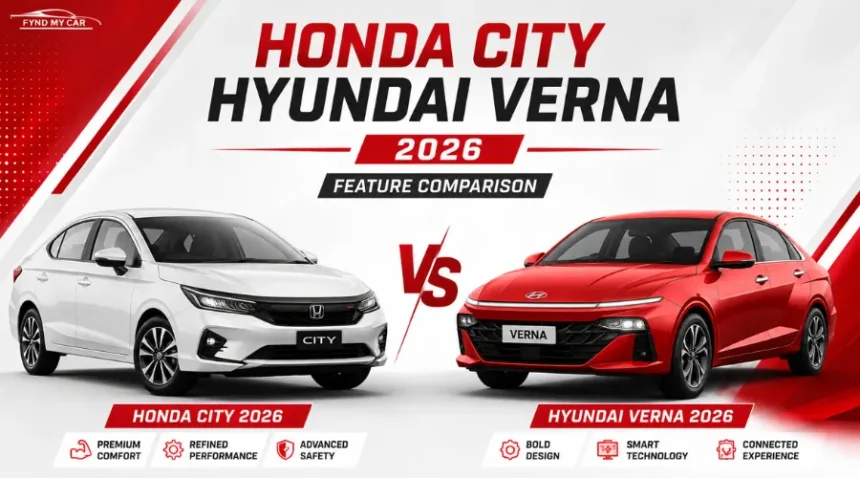
You have picked up two cars, taken them out for a drive, yet are now unsure which to choose. Then, which of these two cars will you be buying – Honda City vs Hyundai Verna 2026?
Undoubtedly, it is one of the toughest decisions for customers in the Indian car market, as both sedans have quite a lot going for them. While one is defined by reliability, the other comes equipped with a series of features that seem revolutionary for the time being.
Both models received notable updates before 2026 began. The company introduced the facelifted fifth-generation Honda City to its owners on May 22, 2026. In contrast, Hyundai offered a fresh update of the Verna earlier in 2026. If you happen to be sitting tight on a budget of around ₹12- ₹20 lakh and are having trouble deciding which one is right for you, then read on.
Honda City vs Hyundai Verna 2026: Quick Comparison Table
| Feature | Honda City 2026 | Hyundai Verna 2026 |
| Starting Price (ex-showroom) | ₹12.00 lakh | ₹10.98 lakh |
| Top Variant Price | ₹20.00 lakh (Hybrid ZX) | ₹18.40 lakh |
| Engine Options | 1.5L NA Petrol + Strong Hybrid | 1.5L NA Petrol + 1.5L Turbo Petrol |
| Power (NA Petrol) | 119 bhp / 145 Nm | 115 bhp / 144 Nm |
| Power (Performance Option) | 98.6 bhp (Hybrid) | 160 bhp / 253 Nm (Turbo) |
| Mileage (NA Petrol) | 18.4 kmpl | 20.6 kmpl |
| Mileage (Best Option) | 27.26 kmpl (Hybrid) | 20.6 kmpl |
| Boot Space | 506 litres | 528 litres |
| Length | 4,553 mm | 4,535 mm |
| Wheelbase | 2,600 mm | 2,670 mm |
| Airbags | 6 (standard on top trims) | 6 standard, 7 on top variants |
| ADAS | Level 2 (Honda Sensing) | Level 2 (available on select variants) |
| Infotainment | 8-inch touchscreen | Dual 10.25-inch screens |
| Sound System | Standard speakers | 8-speaker Bose (top variants) |
Price: Which One Is Easier on the Wallet?
Well, price is the obvious starting point for any comparison. The Verna wins marginally on initial price, with its lowest variant priced at ₹10.98 lakh compared to the City, which starts at ₹12.00 lakh. This may mean a difference of ₹1 lakh, which could significantly affect your budget. However, comparing the base models of both vehicles is pointless, as the real selling point lies in the higher trim levels. While the maximum price point for the Hyundai Verna is ₹18.40 lakh, the City goes up to ₹20.00 lakh (for hybrids).
If we were talking only of petrol variants, however, the maximum price point for the City is at approximately ₹16.50 lakh, whereas the Verna is available up to ₹18.40 lakh. The City’s hybrid model is, again, another kettle of fish entirely.
Verdict: Verna is cheaper at entry and offers more variants to choose from. City’s pricing makes more sense if the hybrid is on your radar.
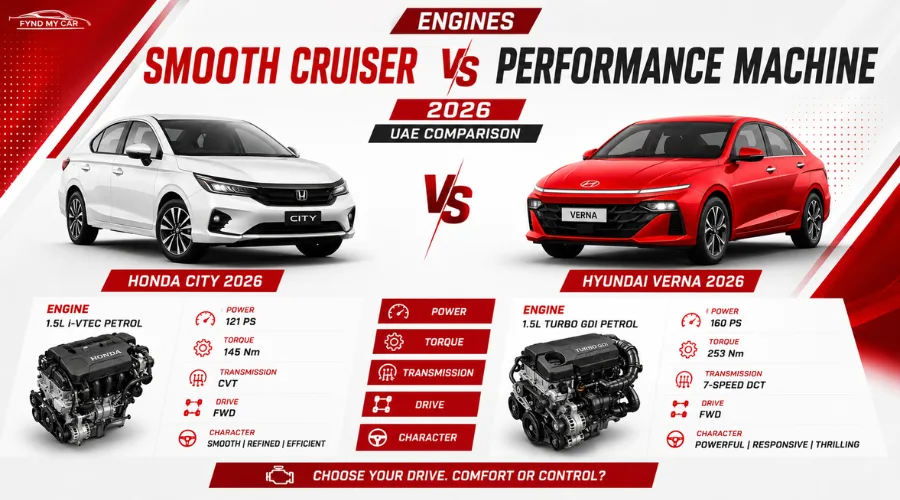
Engines: Smooth Cruiser vs Performance Machine
This is where the two cars take distinctly different paths, and it’s one of the most important differences to understand.
Honda City
The City comes with a 1.5-liter naturally aspirated petrol engine making 119 bhp and 145 Nm of torque. It’s available with a 6-speed manual or a CVT automatic. There’s also the strong hybrid variant, which delivers a remarkable 27.26 kmpl of certified fuel efficiency, the best in the segment by a wide margin.
While the NA engine may not be the most fun thing on the roads, it is definitely smooth and predictable. The Honda i-VTEC engine has earned the trust of many Indian families over the years for several reasons. For starters, it is silent, powerful, and reliable.
Hyundai Verna
The Verna gives you a choice. You can go with the same kind of 1.5-liter NA petrol (115 bhp, 144 Nm) for everyday driving, or you can step up to the 1.5-liter turbo-petrol engine that makes a punchy 160 bhp and 253 Nm of torque.
The turbo engine is combined with the 7-speed Dual Clutch Transmission (DCT), which provides a true response from the car when pressing the pedal. From the perspective of those who enjoy driving a car for pleasure rather than simply traveling somewhere, the Verna turbo is a great experience at this price point. However, there is a drawback: the turbo version’s fuel economy suffers compared to the non-turbo model. Moreover, the DCT transmission may seem reluctant in urban traffic jams.
Verdict: The City scores higher in refinement and efficiency (especially hybrid). The Verna scores higher in power output, especially with the turbocharged engine. If you travel mostly on highways, then you will enjoy the Verna, especially its turbocharged model. Otherwise, you will prefer the City, especially its hybrid.
Boot Space: Practicality That Actually Matters on Road Trips
For a sedan buyer, boot space is a big deal. You’re picking a sedan over an SUV partly because it looks elegant, but you still need it to carry three large suitcases for that family trip to Shimla.
The Hyundai Verna offers 528 liters of boot space, which is the largest in the mid-size sedan segment. To put that in perspective, you can comfortably fit three to four large suitcases in there. The Honda City offers 506 liters, still generous, and more than enough for most families, but 22 liters less than the Verna. In practical terms, this difference is unlikely to cause problems on most trips, but the Verna does have the edge. What also helps the Verna here is its wider body. At 1,765 mm wide, it’s broader than the City, giving both the boot and the cabin a slightly more spacious feel.
Verdict: The City scores higher in refinement and efficiency (especially hybrid). The Verna scores higher in power output, especially with the turbocharged engine. If you travel mostly on highways, then you will enjoy the Verna, especially its turbocharged model. Otherwise, you will prefer the City, especially its hybrid.
Driving Experience: What Does It Feel Like Behind the Wheel?
This is the category that brochures can’t fully capture. You need to feel it.
Honda City on Indian Roads
Comfort was the Honda City’s design intent from the start. It soaks up all those potholes and speed bumps with ease. The ride quality is such that you feel it taking care of itself, with little to bother the driver. The steering becomes extremely light in the city, while the power delivery is smooth and linear. The facelifted variant, slated for release in 2026, is said to feature a revised suspension setup to better suit Indian road conditions. The CVT makes driving in traffic a breeze as you don’t have to hunt for gears because, to put it simply, there aren’t any.
Hyundai Verna on Indian Roads
The Verna is a more involved experience, particularly in the turbo variant. The DCT gearbox is sharp, and the throttle response is more eager. You feel more connected to the car, and when you want to overtake someone on the highway, the Verna obliges without hesitation. The Verna’s longer wheelbase of 2,670 mm (compared to 2,600 mm in the City) gives it excellent high-speed stability. On long stretches of highway, it feels planted and confident. The wider body also means more shoulder room for rear passengers. In city traffic, the NA Verna is comfortable. The turbo DCT variant, however, can sometimes feel jerky at very low speeds, a known characteristic of DCT gearboxes, not specific to just Hyundai.
Verdict: City for smooth, relaxed, everyday driving. Verna for drivers who want a more engaged experience and are willing to occasionally deal with the DCT’s city behavior.
Premium Feel Inside: Who’s Doing More to Impress You?
Walk into both cars, and you’ll immediately notice that they’ve gone about “premium” in different ways.
Inside the Honda City
The Honda City‘s cabin is clean, well-organized, and built with quality materials. The plastics feel sturdy, there’s minimal flex when you press panels, and the seat fabric (or leatherette on higher trims) has a premium texture that holds up well over the years. The layout is intuitive. You never feel lost looking for a button. Honda offers an 8-inch touchscreen infotainment system with wireless Android Auto and Apple CarPlay, wireless charging, and a digital instrument cluster on higher variants.
There’s also an electric sunroof. It’s not the flashiest setup in the class, but everything works the way it should, every single time. The rear seat, despite the slightly smaller wheelbase, is comfortable for two adults with adequate legroom. Three adults across the rear are a bit snug on long journeys.
Inside the Hyundai Verna
The Verna’s interior feels like Hyundai is trying to show off, and they’re largely succeeding. The dual 10.25-inch screens (one for infotainment, one for instrument cluster) look genuinely impressive. The 8-speaker Bose sound system on the top variants is noticeably better than anything else in this segment. You also get ventilated and heated seats, 64-color ambient lighting, a 360-degree camera, and an electronic parking brake. These are the features you’d typically find in a car costing significantly more. The 2026 update also adds a dashcam to the package on certain variants.
There’s a 7th airbag (a driver’s knee airbag) on top variants, which is a meaningful safety addition. The Verna’s cabin feels more modern and feature-rich. If you’ve ever sat in a friend’s Hyundai and thought, ‘ Why doesn’t my car have this? ‘ the Verna might be your answer.
Verdict: Verna wins the “wow” test. It looks more premium and is packed with features. The city wins the “quality and ease of use” test. It feels more thoughtfully put together, even if it doesn’t dazzle at first glance.
Honda City vs Hyundai Verna 2026 Safety Features
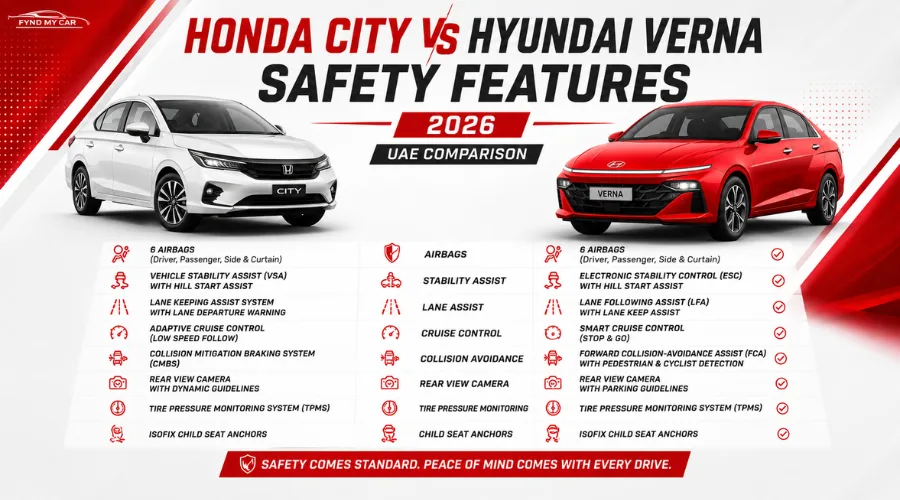
Both cars come with ADAS Level 2 safety features, 6 airbags, ABS with EBD, electronic stability control, and TPMS as standard. One meaningful advantage for the City: Honda Sensing ADAS is offered across both manual and automatic variants — not just the automatic. This means buyers who prefer a manual gearbox don’t have to give up active safety features, which is a genuine differentiator. The Verna’s ADAS is available on select variants, and the top-spec variant gets the 7th airbag (driver’s knee airbag). Both cars have received strong safety ratings.
Verdict: Both cars are safe. The city makes ADAS more accessible across variants. Verna has more airbags at the top end.
Who Should Buy Which?
After all this data and all these angles, it really comes down to what you want from your sedan.
Buy the Honda City if:
- Long-term reliability and low maintenance are important to you
- You want the hybrid for exceptional fuel efficiency (27+ kmpl)
- You drive mostly in the city and want a smooth, stress-free experience
- You prefer an understated, clean design over flashy features
- You want ADAS even in a manual variant
Buy the Hyundai Verna if:
- You want more features for your money
- The turbo engine’s performance excites you
- A more premium, feature-rich interior matters to your daily experience
- Boot space is a priority for your family’s travel needs
- You want dual screens and a Bose sound system as part of your daily commute soundtrack
Final Word
The Honda City and Hyundai Verna have been rivals for years, and in 2026, they’re closer than ever, but in very different ways. The City has become the most fuel-efficient sedan in India thanks to its hybrid powertrain, while the Verna has become the most feature-loaded in this price range. There’s no wrong answer here. The City is a car you’ll trust for the next 10 years without a second thought. The Verna is a car you’ll enjoy every time you get in. One takes care of you. The other excites you. Depending on the kind of driver you are, you already know which one feels right.
FAQ
1. Which is more fuel-efficient, the Honda City or the Hyundai Verna?
A. The Honda City Hybrid wins by a mile at 27.26 kmpl. For regular petrol variants, the Verna (20.6 kmpl) edges out the City (18.4 kmpl).
2. Which car has more boot space?
A. The Verna, with 528 liters vs the City’s 506 liters. Not a dramatic difference, but the Verna does fit more luggage on longer trips.
3. Is the Hyundai Verna turbo worth the extra money?
A. If you enjoy driving and spend time on highways, yes. You get 160 bhp and seriously quick overtaking ability. For city-only use, the NA petrol is more than enough.
4. Which is better for a family of four?
A. Both work well. The Verna’s longer wheelbase (2,670 mm vs 2,600 mm) gives rear passengers slightly more knee room, making it a touch more comfortable for families on long drives.
5. Which one is easier to maintain long-term?
A. The Honda City. Honda’s service network and reputation for low-cost, reliable maintenance gives it an edge here. Spare parts are widely available and service costs tend to be lower over time.