
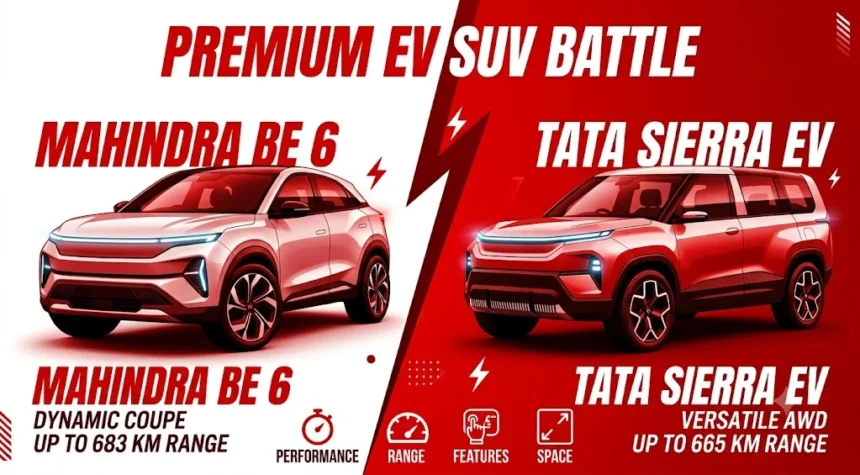
So you’ve shortlisted two of India’s most talked-about electric SUVs, the Mahindra BE 6 and the Tata Sierra EV, and now you’re stuck staring at both tabs open on your phone, not sure which one to click “book now” on? You’re not alone.
Both cars have shown up at almost the same price point, both look like nothing else on Indian roads, and both promise big range numbers on paper. But once you dig a little deeper, the two SUVs are built for slightly different kinds of buyers, and this comparison should help you figure out which one is right for you.
We’ve put together everything you need in one place, from the price of every variant to the tiniest safety feature, so you don’t have to open ten browser tabs to make sense of it all.
Mahindra BE 6 Vs Tata Sierra EV 2026: Key Specs Difference
| Specification | Mahindra BE 6 | Tata Sierra EV |
| Battery Options | 59 kWh / 79 kWh | 63 kWh / 75 kWh |
| Claimed Range (ARAI/MIDC) | Up to 683 km | Up to 665 km |
| Peak Power | Up to 286 PS | Up to 313 bhp (AWD) |
| Peak Torque | 380 Nm | 504 Nm |
| 0-100 kmph | 6.7 seconds | 5.8 seconds |
| Drive Layout | RWD | RWD / AWD (QWD) |
| DC Fast Charging | Up to 175 kW | Up to 120 kW |
| AC Charging | 7.2 / 11.2 kW | 7.2 kW (optional) |
| Length x Width x Height | 4371 x 1907 x 1627 mm | 4340 x 1841 x 1750 mm |
| Wheelbase | 2775 mm | 2730 mm |
| Boot Space | 455 litres | 622 litres (1257 L folded) |
| Ground Clearance | 207 mm | 205 mm |
| Infotainment | Twin 12.3-inch screens, AR HUD | Triple screen setup |
| ADAS | Level 2 | Level 2 (22 features) |
Price Differences
Let’s talk numbers first, because that’s usually what decides the shortlist anyway. The Mahindra BE 6 starts at Rs. 18.90 lakh (ex-showroom) for its base Pack One variant and goes all the way up to around Rs. 27.40 lakh for the fully loaded Pack Three trim with the bigger battery. The Tata Sierra EV, on the other hand, starts almost identically at Rs. 18.79 lakh and tops out closer to Rs. 26.48 lakh for the Empowered A variant. So on paper, there are barely a few thousand rupees separating the two at the entry level, which makes this a genuinely close fight rather than a one-sided one.
Where things get interesting is in the middle of the range. Mahindra spreads the BE 6 across nearly twenty variants, letting buyers pick very specific combinations of battery size and features, which is great if you like fine-tuning your purchase but can feel a bit overwhelming too. Tata keeps things simpler with just five trims: Pure, Pure S, Adventure, Empowered, and Empowered A. If you want all-wheel drive on the Sierra EV, you’ll need to stretch to the Empowered A trim specifically, whereas the BE 6’s higher trims focus more on tech and comfort than on adding a second motor.
Variant Differences
The BE 6’s variant lineup is built around two battery packs, a 59kWh one and a bigger 79kWh one, and Mahindra offers most trims like Pack One, Pack One Above, Pack Two, and Pack Three across both. This means you could buy a well-equipped BE 6 with the smaller battery instead of stretching your budget purely to get more range, which is a nice bit of flexibility. The catch is that Mahindra’s naming convention isn’t always intuitive at first glance, so it does take a bit of research on their configurator before you know exactly what you’re paying for at each level.
Tata’s variant structure on the Sierra EV feels more straightforward for anyone comparing showroom brochures side by side. Pure and Pure S are the sensible, value-focused trims, Adventure adds a bit more visual flair, and Empowered plus Empowered A bring in the premium features along with the option of dual-motor all-wheel drive. Only two of the sixteen total configurations get this AWD setup, badged QWD by Tata, so if all-wheel grip matters to you, you’ll be looking squarely at the top end of the Sierra EV lineup rather than the middle trims.
Features Differences
Both these SUVs are absolutely loaded for their price bracket, and honestly, spec sheets alone won’t tell you the full story, so we’ve broken down the important numbers in a simple table below. The BE 6 leans into performance figures and a sportier driving feel, while the Sierra EV focuses on outright space and a more rounded ADAS package with slightly more safety features baked in as standard. Reading through the raw numbers side by side is the quickest way to figure out which car’s priorities line up with your own daily needs, whether that’s outright acceleration, boot space, or charging speed.
Design Differences
Park these two next to each other, and you’ll immediately see how differently Mahindra and Tata approached the same brief. The BE 6 goes for a low-slung, coupe-like silhouette with sharp creases, a sloping roofline, and a rear end that looks like it borrowed styling cues from a race car, right down to the centrally placed reverse light. It’s the kind of design that turns heads at a traffic signal, and Mahindra clearly built it for buyers who want their SUV to look fast even when it’s parked. The piano black cladding does look premium, though it’s known to scratch and show dust rather easily over time.
The Sierra EV takes the opposite route by staying true to the boxy, upright stance that made the original Sierra iconic decades ago, complete with that signature glass-roofed silhouette reinterpreted for 2026. It looks taller, more upright, and honestly more practical from the outside, with flush door handles and blacked-out pillars giving it a clean, modern finish rather than an aggressive one. If you’ve always liked SUVs that look like SUVs rather than crossovers pretending to be sports cars, the Sierra EV’s design language is going to feel far more natural and familiar to you.
Comfort Differences
Cabin space is where the Sierra EV pulls ahead quite noticeably, and it comes down to basic geometry more than anything else. Its taller, boxier body translates into a genuinely airy rear seat with more headroom and a flatter floor, which matters a lot on longer family drives. The 622-litre boot is also considerably bigger than what the BE 6 offers, and it expands to a massive 1257 litres once you fold the rear seats down. For families who prioritize practicality, this extra room for luggage and rear passengers is going to matter more than any spec sheet number.
The BE 6, in comparison, prioritises a cockpit-like front cabin experience over outright space, and several reviewers have pointed out that rear seat comfort for taller passengers isn’t quite as generous, partly because of that sloping roofline. That said, the front seats feel sportier and more snug, the ventilated seating is excellent, and the general fit and finish feels genuinely upmarket. The ride quality on both cars leans towards the firmer side, since bigger wheels and stiffer suspension setups are needed to handle the weight of their large battery packs comfortably.
Engine, Mileage and Powertrain Differences
Since both of these are fully electric SUVs, there’s no traditional engine or mileage in the petrol-diesel sense, but the powertrain story is still worth understanding properly. The BE 6 offers a single rear-mounted motor across its lineup, producing up to 286 PS and 380 Nm of torque from the bigger battery pack, enough for a 6.7 second 0-100 kmph sprint. It’s tuned to feel quick and eager rather than outright brutal, which suits its sporty positioning. Mahindra has stuck with a rear-wheel-drive-only approach here, so there’s no all-wheel-drive variant available if you’re expecting one.
Tata goes a step further on the Sierra EV by offering an optional dual-motor all-wheel-drive setup on the Empowered A variant, badged QWD, which pushes power up to 313 bhp and torque to a much higher 504 Nm. This combination lets the top Sierra EV hit 100 kmph from a standstill in just 5.8 seconds, genuinely quick for an SUV this size and one of Tata’s fastest production vehicles yet. Both cars support fast DC charging that can top up a meaningful chunk of range in around 20 to 30 minutes, making daily and highway use fairly stress-free either way.
Safety Features Differences
Safety is one area where both these SUVs have clearly been engineered with a lot of care, and neither feels like it’s cutting corners to hit a price point. The Mahindra BE 6 comes with up to seven airbags on its top variant, covering the driver, front passenger, both curtains, and knee protection for the driver, along with a full electronic stability program, traction control, and a 360-degree camera system as standard on higher trims. It carries a 5-star Bharat NCAP safety rating, and Mahindra has also included Level 2 ADAS with features like adaptive cruise control and lane assistance across most of its variant range.
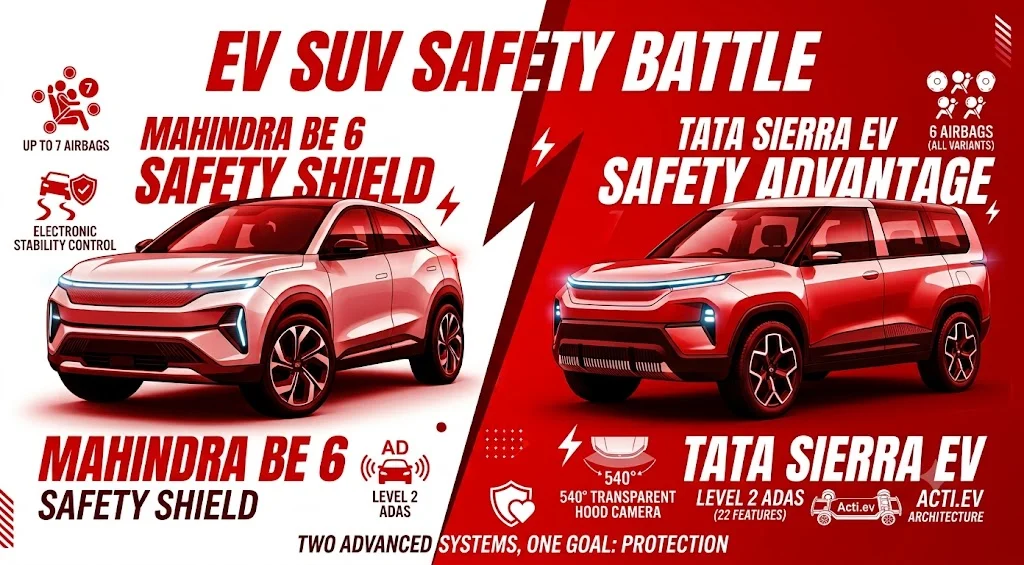
The Tata Sierra EV counters with six airbags on its highest trim and a genuinely comprehensive Level 2 ADAS suite spanning 22 individual safety and driver-assistance features, which is a notably longer list than most rivals in this segment offer. It also gets a 540-degree surround-view camera with a transparent mode for tricky off-road sections, six terrain modes on the all-wheel-drive variant, and a strong body structure built on Tata’s Acti.ev architecture. Both brands have also built in robust battery protection systems, since keeping the battery pack safe during a crash is just as important as protecting the occupants inside the cabin.
Beyond the headline numbers, it’s worth remembering that real-world safety also depends on how these systems behave in daily driving, not just how they read on a spec sheet. Reviewers testing both SUVs have generally found the ADAS systems on each car to be fairly reliable in highway conditions, though, like most Level 2 systems in India right now, they occasionally struggle with unmarked lanes or unpredictable local traffic. If safety tech is a top priority for you, the Sierra EV’s longer feature list might edge it slightly, but the BE 6’s 5-star rating and airbag count keep it firmly in the same league.
Final Thoughts
So which one should you actually buy? Honestly, it depends on what kind of driver you are and what your daily life looks like. If you want an SUV that feels sporty and looks like nothing else in the parking lot, the Mahindra BE 6 will put a bigger smile on your face. It’s the more emotional choice of the two, built for someone who wants their electric SUV to feel special rather than just sensible.
If your priorities lean towards space, practicality, and a slightly more complete safety package, the Tata Sierra EV makes a very strong case for itself too. The bigger boot, roomier rear seat, longer ADAS feature list, and the option of proper all-wheel drive make it the more well-rounded family SUV of the two. Either way, you’re not making a bad decision, since both cars represent genuinely serious steps forward for Indian electric SUVs.
FAQ
1. Which is better: Mahindra BE 6 or Tata Sierra EV?
A. The Mahindra BE 6 is better for buyers who want sporty styling and strong performance, while the Tata Sierra EV is a better choice for families looking for more space, practicality, and AWD.
2. Which EV SUV offers a longer driving range?
A. The Mahindra BE 6 offers a claimed range of up to 683 km, slightly higher than the Tata Sierra EV’s 665 km.
3. Does the Tata Sierra EV come with all-wheel drive?
A. Yes, the Tata Sierra EV offers an optional dual-motor all-wheel-drive (QWD) system on its top Empowered A variant.
4. Which SUV has a bigger boot space?
A. The Tata Sierra EV has a larger 622-liter boot, expandable to 1,257 liters with the rear seats folded, making it more practical for luggage.
5. Are both the Mahindra BE 6 and the Tata Sierra EV safe?
A. Yes. Both electric SUVs offer Level 2 ADAS, multiple airbags, and advanced safety technologies, making them among the safer EVs in their segment.