
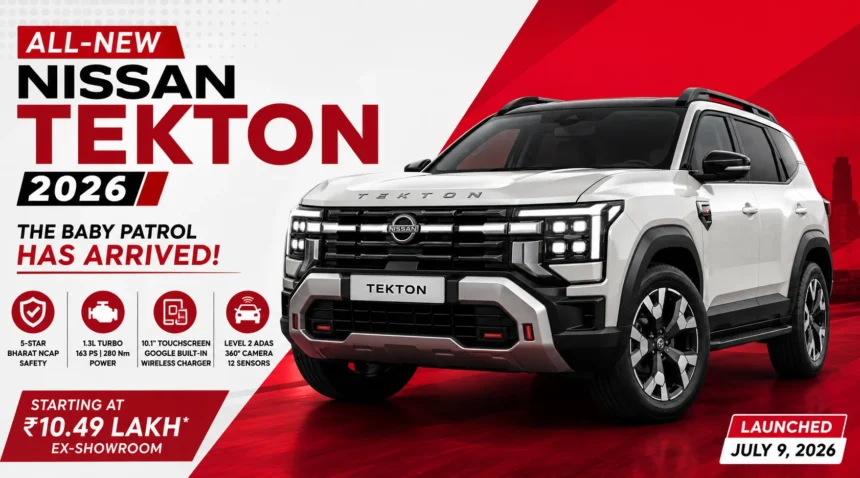
Ever wondered what Nissan has been quietly working on while Hyundai and Tata fought it out for the mid-size SUV crown in India? Meet the Tekton.
This car debuted on July 9, 2026, and is shaping up to be one of the most talked-about launches of the year. Nissan is calling it the “Baby Patrol,” and once you see the front end, you’ll understand exactly why. Here’s a simple breakdown of everything you need to know about it.
Nissan Tekton 2026: Key Specifications
Here’s a quick look at the key specs.
| Specification | Details |
| Platform | CMF-B (shared with Renault Duster) |
| Length | 4,300 mm (approx.) |
| Body Type | Mid-size / C-SUV |
| Seating Capacity | 5 (7-seater version planned for 2027) |
| Engine Options | 1.0L Turbo Petrol (T160), 1.3L Turbo Petrol (T280) |
| Transmission | 6-Speed Manual, 6-Speed Wet Clutch DCT |
| Power (1.0L) | 100 PS at 5,000 rpm |
| Torque (1.0L) | 166 Nm at 2,000–3,750 rpm |
| 0-100 kmph (1.0L MT) | 12.46 seconds |
| Fuel Efficiency (1.0L MT) | 19.4 kmpl |
| Infotainment | 10.1-inch touchscreen with Google built-in |
| Sunroof | Panoramic, anti-pinch, one-touch |
| Airbags | 6 |
| Safety Rating | 5-Star Bharat NCAP (Adult & Child) |
Price and Variants
Nissan has chosen an introductory pricing strategy to make the Tekton difficult to overlook from the start. There are six trim levels in the lineup, from a well-equipped base model to a flagship with lots of features. Prices are initial and ex-showroom, therefore they may change once the promotion period expires.
| Variant | Ex-Showroom Price (Introductory) |
| Visia | ₹10,49,000 |
| Visia+ | ₹11,14,000 |
| Acenta | ₹11,79,000 |
| N-Connecta | ₹13,69,000 |
| Tekna | ₹15,39,000 |
| Tekna+ | ₹16,49,000 |
Interestingly, the entry-level Visia isn’t a stripped-down model either. It still comes with a 7-inch digital instrument cluster and electrically adjustable mirrors, so even budget buyers aren’t left feeling shortchanged.
Key Features
Some standout features worth mentioning separately: a 360-degree camera with 12 sensors and 4 cameras, an Arkamys 3D surround sound system, a wireless active-cooled phone charger, dual-zone climate control with voice control, and connected car tech through the MyNissan app that lets you lock, unlock, and even start the AC remotely from your phone.
Exterior Design
Nissan wasn’t exaggerating when it said the Tekton borrows heavily from the Patrol. The front gets a wide chrome grille with the Patrol-style silver accents, a set of sharp C-shaped LED headlamps stacked in a five-chamber cluster, and a seriously chunky bumper with a skid plate that gives it an off-road-ready look. The bonnet is tall and muscular, with “TEKTON” lettering stamped right across it, which is a nice touch of confidence.
Move to the side and you’ll notice roof rails that sit flush with the body, a squared-off silhouette, and handsome 18-inch diamond-cut alloy wheels with a five-petal design. At the back, a connected LED light bar runs between C-shaped tail lamps, and there’s an integrated spoiler that adds a sporty edge without looking over the top. It’s underpinned by the same CMF-B platform as the Renault Duster, but Nissan has done a solid job of making sure the two don’t look like siblings.
Interior And Comfort
Step inside and the cabin feels like a proper step up from what Nissan usually offers in this price bracket. There’s a dual-screen setup with a 10.25-inch digital driver’s display and a 10.1-inch touchscreen infotainment unit, both angled toward the driver for that cockpit-style feel. The seats come in leatherette upholstery with contrast stitching, and on the higher trims, they’re powered, ventilated, and even have adjustable lumbar support.
You also get a panoramic sunroof with anti-pinch tech and one-touch operation, ambient lighting that can shift through 48 colours, and a fly-by-wire electronic gear shifter on the automatic version. Nissan has thrown in a Plasmacluster air purifier with an air quality display too, which is a genuinely useful addition given how polluted Indian cities can get. Overall, it feels less like a facelifted Duster and more like Nissan built its own identity around the same bones.
Engine, Mileage, and Powertrain
The Tekton skips the hybrid route for now and sticks to two turbo-petrol engines, both borrowed from the Duster’s playbook. The base engine is a 1.0-litre, three-cylinder turbo-petrol putting out 100 PS and 166 Nm, paired only with a 6-speed manual gearbox. It’s tuned more for smooth, everyday driving than outright thrills, and it returns a claimed fuel efficiency of 19.4 kmpl, which is decent for a turbo-petrol SUV of this size.
The bigger draw is the 1.3-litre turbo-petrol, badged T280, which is one of the strongest engines in its class. It’s expected to make around 163 PS and 280 Nm of torque, giving it a genuine performance edge over most rivals. This one is available with both the 6-speed manual and a 6-speed wet-clutch DCT automatic, complete with paddle shifters for those who like to take control. There was earlier talk of a 1.8-litre strong-hybrid version joining later, but recent reports suggest Nissan may leave that engine exclusive to the Duster instead, at least for now.
Safety Features
Safety is clearly one area Nissan wanted to lead with, and it shows. The Tekton has already bagged a 5-star Bharat NCAP rating for both adult and child occupant protection, built around a body shell that uses 62% high-strength and ultra-high-strength steel in the pillars.
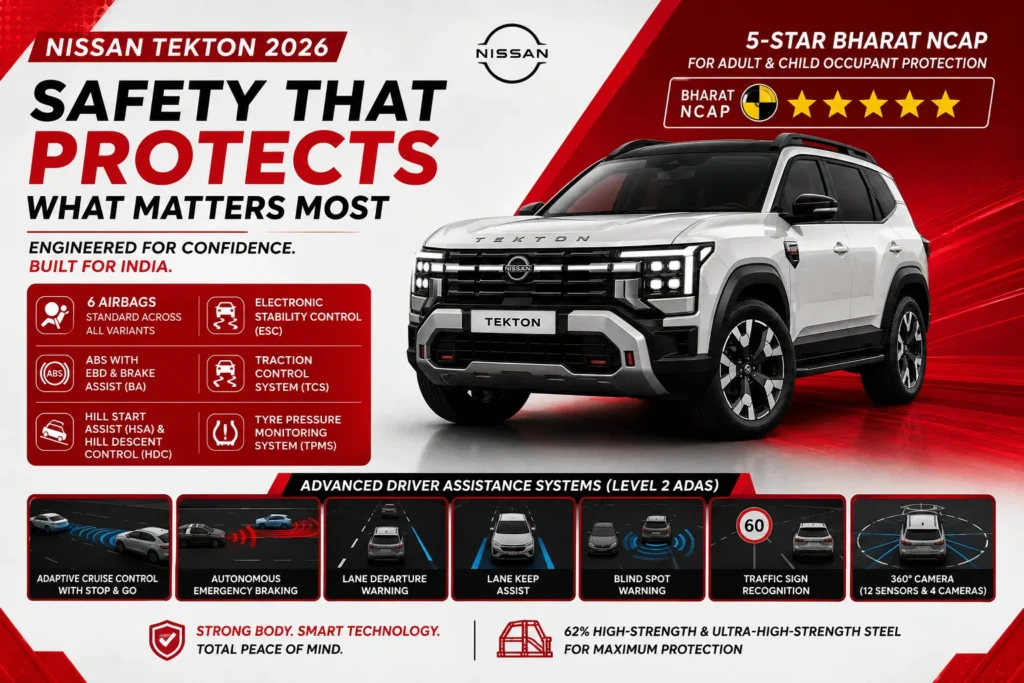
Six airbags come standard across the range, not just on the top trim, which is a welcome move. Beyond that, you get electronic stability control, traction control, autonomous emergency braking, lane departure warning, lane keep assist, blind spot warning, traffic sign recognition, and adaptive cruise control with stop-and-go functionality. Put together, this is essentially a Level 2 ADAS package, and having it trickle down to more affordable trims would be a big win for buyers who usually have to pay a premium for this kind of tech.
Nissan Tekton Rivals
The Tekton isn’t walking into an easy fight. The Hyundai Creta still rules this segment by a wide margin, and then there’s the Kia Seltos, Maruti Grand Vitara, Maruti Victoris, Skoda Kushaq, VW Taigun, Toyota Hyryder, Honda Elevate, and MG Astor, all fighting for the same buyer. Its closest relative is actually the Renault Duster, since both share the same platform underneath. The upcoming Tata Sierra adds one more name to an already packed list. With so many strong options on the table, the Tekton needs more than sharp looks to win people over.
Conclusion
So, does the Nissan Tekton 2026 have what it takes? On paper, yes. It brings a bold design, a genuinely powerful engine, a long feature list, and a five-star safety score to a segment where buyers usually have to compromise on one of these. Nissan has clearly done its homework here. The real test will come once it hits the roads and owners start sharing their day-to-day experience, especially around service costs and resale value. But as a first impression goes, the Tekton feels like Nissan’s most confident and competitive SUV in India in a very long time.
FAQs
1. When was the Nissan Tekton launched in India?
A. The Nissan Tekton made its official debut on July 9, 2026.
2. What is the starting price of the Nissan Tekton?
A. The Prices begin at ₹10.49 lakh (ex-showroom) for the base Visia variant.
3. What engines does the Tekton come with?
A. There’s a 1.0L turbo-petrol with 100 PS and a more powerful 1.3L turbo-petrol with around 163 PS, paired with manual or DCT automatic gearboxes.
4. Is the Nissan Tekton safe?
A. Yes, it has earned a 5-star Bharat NCAP rating for both adult and child occupant protection, with six airbags as standard.
5. Which cars will the Tekton compete against?
A. The Tekton mainly competes with the Hyundai Creta, Kia Seltos, Maruti Grand Vitara, Skoda Kushaq, VW Taigun, Honda Elevate, and its own cousin, the Renault Duster.