

Are you torn between the petrol and diesel Mahindra Thar Roxx review, wondering which one truly fits your life, your roads, and your wallet better? I get it. When a car pulls at your heart and your head at the same time, the decision can feel heavy. You’re not just buying a vehicle here; you’re choosing a lifestyle companion.
I’m writing this to help you, not confuse you. We’ll talk about how the petrol and diesel Thar Roxx feel to live with every day. By the end, I want you to feel confident, calm, and clear about which option is right for you.
Key Considerations for Decision Making
Before you pick between petrol and diesel, it helps to pause and think about how you actually plan to use your Thar Roxx. These small, everyday details can make a big difference in how happy you feel with your choice later.
Running Costs & Usage
Let’s start with the money part, because you and I both know it matters after the excitement settles. If your daily driving is limited and mostly within the city, the petrol Thar Roxx usually costs less to run in the short term. It costs a bit less to buy and doesn’t make you worry too much if your monthly driving is low. On the other hand, if you travel frequently or take long trips, the diesel version makes more sense. Diesel fuel often goes further on a single tank, so over time, especially with heavy use, it can save you money. I always tell people: think about how much you actually drive, not how much you wish you drove.
City vs. Highway
In the city, the petrol Thar Roxx feels smoother and quieter. It doesn’t feel stressed in traffic, and short drives feel relaxed. If your routine is school runs, office commutes, or quick errands, petrol fits nicely into that rhythm. Diesel, however, really feels at home on open roads. On highways, it feels steady and calm, almost like it’s asking you to keep going. If you love long drives, road trips, or weekend escapes, the diesel option offers effortless ease. So ask yourself: are you more of a city cruiser or a highway wanderer?
4×4 Availability
Now let’s talk adventure, because that’s what the Thar Roxx is all about. Both petrol and diesel versions offer the option of 4×4, which means you’re not missing out either way. If you enjoy off-road trails, hills, sand, or slushy roads during the rains, you’ll be happy with both. That said, many serious off-roaders lean toward diesel because it offers greater confidence when the terrain gets tough. If your adventures are occasional and more about style than extreme trails, petrol will still keep you smiling.
Transmission
This is where comfort really comes in. Both petrol and diesel Thar Roxx are available with manual and automatic transmissions. If you enjoy being fully involved while driving and don’t mind shifting gears, a manual can be fun. But if you’re like me and value ease, especially in traffic, automatic just makes life simpler. The petrol automatic feels especially smooth in stop-and-go conditions. Diesel automatic, meanwhile, feels relaxed on long journeys. There’s no wrong choice here, only what suits your patience level and daily stress.
Resale Value
Even if you don’t plan to sell your car anytime soon, resale value is worth thinking about. Diesel vehicles traditionally hold their value better, especially in markets where long-distance driving is common. Over time, you may find more buyers interested in a diesel Thar Roxx. Petrol resale is decent too, but diesel often has a slight edge. If you want to know your car will remain in demand in the future, diesel offers that extra peace of mind.
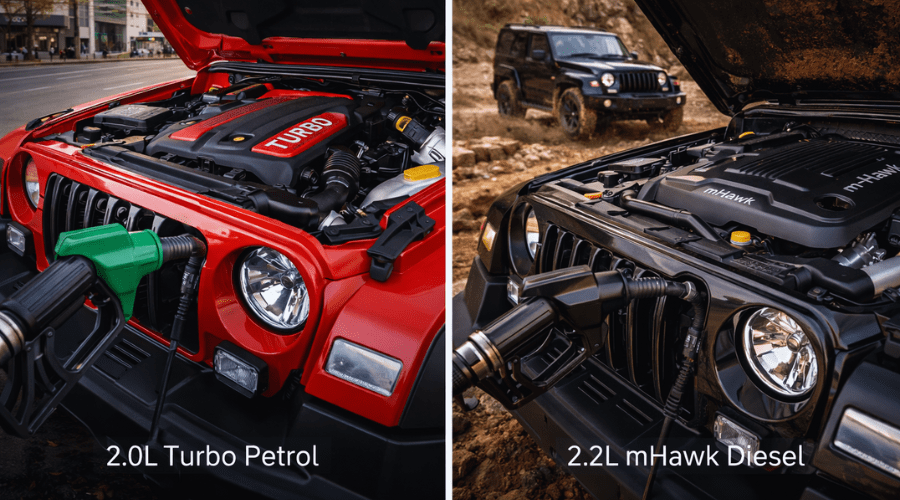
Mahindra Thar Roxx Petrol (2.0L Turbo) — Pros and Cons
Pros
- Strong power and torque figures: The petrol’s 2.0-liter turbo engine makes up to about 130 kW (roughly 175 PS) and a healthy 380 Nm torque, which gives it a nice punch in city and highway driving. That means it doesn’t feel sluggish when you accelerate or overtake.
- Smooth and responsive driving: The petrol engine revs a bit more freely and feels calm at low speeds, which is perfect for everyday city traffic.
- Automatic option feels relaxed: With the 6-speed automatic gearbox, the petrol Thar Roxx is very easy to live with in bumper-to-bumper traffic.
- Good balance of performance and fun: The torque isn’t just a number. It helps the SUV feel willing and engaging when you press the accelerator.

Cons
- Fuel efficiency is lower: According to the current auto news articles, petrol engines generally drink more fuel than diesels, so if you rack up the kilometers, your wallet might feel it sooner. Official efficiency figures hover on the lower end compared to diesel.
- Feels heavier on fuel long trips: On long highways, diesel alternatives usually suppress petrol because they’re built to run efficiently over distance.
- Less confidence on tough terrain: While the petrol Roxx is capable, some serious off-road-oriented drivers feel diesel’s torque curve gives it a slight edge when crawling over rocks or mud.
- Weight balance felt different: Petrol engines can feel a bit front-heavy due to their design and placement, which subtly affects steering feel compared to diesel engines.
Mahindra Thar Roxx Diesel (2.2L mHawk) — Pros and Cons
Pros
- Power and torque that suits long drives: The diesel’s 2.2-liter mHawk engine puts out around 128.6 kW (~175 PS) and 370 Nm torque, making it very steady on highways and when towing or climbing.
- Better fuel efficiency: Diesel tends to give you more miles per liter than petrol, which adds up over time if you’re commuting long distances or cruising highways often.
- Great for off-road and heavy use: Diesel engines make torque lower in the rpm range, making them especially good for difficult terrain or when you need strong pulling power without revving hard.
- Resale value tends to be stronger: Because of their utility-oriented nature and demand in the used market, diesel SUVs often hold their value better over time.

Cons
- Slightly less free-revving feel: As per the automobile current news, diesel engines often feel a bit less “lively” or responsive when you quickly mash the accelerator compared to petrol.
- More expensive upfront: Diesel variants generally cost a little more than petrol, not just in price, but sometimes in parts and servicing over time.
- Engine noise: Diesel engines can be noisier and feel rougher under heavy acceleration than petrol engines, especially in city traffic.
- Weight and handling: Diesels are often slightly heavier due to engine components, and in tight city driving, this can make them feel less agile than the petrol version.
Summing Up
Ultimately, choosing the right Mahindra Thar Roxx isn’t just about what’s on paper; it’s about you. Your habits, your roads, your dreams. If your day-to-day is mostly in the city, with occasional getaways, petrol keeps things simple and joyful. If you’re drawn to highways and faraway trails, diesel becomes your loyal companion. Listen to what fits your routine best, and you won’t regret your decision.
FAQ
1. Which Mahindra Thar Roxx is better for daily city driving, petrol or diesel?
A. If most of your driving is in the city with short trips, petrol feels smoother, quieter, and more comfortable to live with every day.
2. Is the diesel Thar Roxx worth the extra money?
A. Yes, if you do a lot of highway driving, long trips, or off-roading. Over time, diesel’s higher price can be offset by better long-distance fuel economy and resale value.
3. Does petrol or diesel make a difference for off-roading?
A. Both can handle rough roads well, but diesel usually feels more confident and steady on tough terrain, especially if off-roading is frequent.
4. Which version has lower maintenance costs?
A. Petrol generally has slightly lower and simpler maintenance, especially if your usage is light to moderate.
5. Will resale value be better for petrol or diesel?
A. Diesel Thar Roxx usually holds its value better in the long run, as many buyers prefer it for touring and adventure use.