
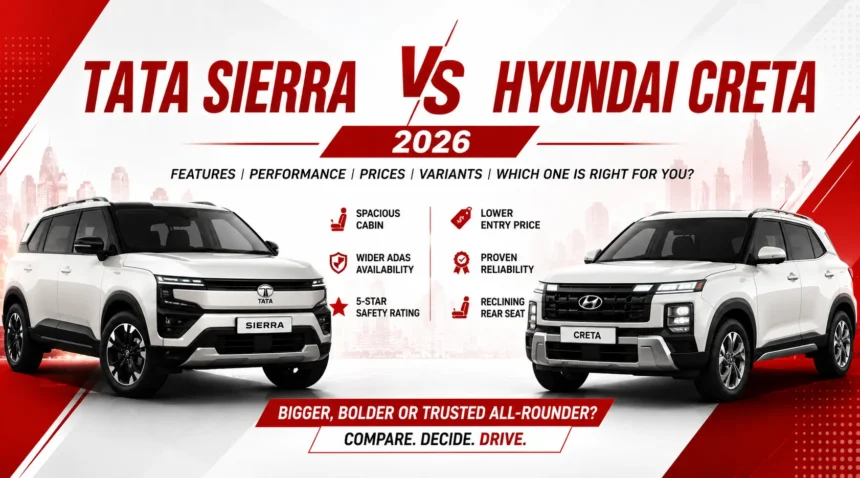
So you’ve narrowed your next SUV down to two cars. Now you’re stuck staring at brochures, wondering whether to go with the nameplate that’s owned India’s heart for a decade, or the comeback everyone’s talking about right now? That’s exactly the dilemma facing many buyers this year.
The Hyundai Creta has been the default answer to “which mid-size SUV should I buy” for almost ten years running, while the new Tata Sierra walked in wearing a badge from the 90s but with thoroughly modern hardware underneath.
Both cars target the same buyer, cost roughly the same, and have genuine strengths. Let’s actually break down where they differ, so you can decide which one deserves a spot in your garage.
Tata Sierra vs Hyundai Creta 2026: Key Specs at a Glance
Numbers rarely lie, so here’s a side-by-side look at how the two stack up on paper.
| Specification | Tata Sierra | Hyundai Creta |
| Length | 4,340 mm | 4,330 mm |
| Width | 1,841 mm | 1,790 mm |
| Height | 1,715 mm | 1,635 mm |
| Wheelbase | 2,730 mm | 2,610 mm |
| Ground clearance | 205 mm | 190 mm |
| Boot space | 450 litres (up to 1,257 litres, seats folded) | 433 litres |
| Seating capacity | 5 | 5 |
| Fuel tank | 50 litres | ~50 litres |
| Engine options | 1.5L NA petrol, 1.5L turbo petrol, 1.5L diesel | 1.5L NA petrol, 1.5L turbo petrol, 1.5L diesel |
| Petrol (NA) power/torque | 106 PS / 145 Nm | 115 PS / 144 Nm |
| Turbo-petrol power/torque | 160 PS / 255 Nm | 160 PS / 253 Nm |
| Diesel power/torque | 116-118 PS / 260-280 Nm | 116 PS / 250 Nm |
| Transmissions | 6-speed MT, 7-speed DCT, 6-speed TC auto | 6-speed MT, CVT, 6-speed TC auto, 7-speed DCT |
| Claimed mileage | 15.3 – 21.26 kmpl | ~17 – 21 kmpl |
| Airbags | 6 (standard) | 6 (standard) |
| ADAS availability | From mid-range trims upward | Only on top King trim |
| Crash test rating | 5-star BNCAP (adult & child) | Not yet tested this generation |
| Sunroof | Panoramic | Panoramic |
| Infotainment | Triple 12.3-inch screens (top trims) | Dual 10.25-inch screens |
| Price range (ex-showroom) | ₹11.49 – ₹21.29 lakh | ₹10.79 – ~₹19.95 lakh |
Here are a few observations that stand out right away. First, the Sierra wins when it comes to size, as it is larger than the Creta in nearly all aspects, namely length, width, height, and wheelbase. A larger wheelbase generally translates to additional legroom in the back seat, and Tata definitely did not overlook this when designing the Sierra’s interior. Second, while the Creta may not compete in terms of size, it offers slightly better fuel economy in some variants.
Difference Of Price and Variants
The Tata Sierra costs from ₹11.49 lakh to ₹21.29 lakh (ex-showroom) and comes with seven trims: Smart+, Pure, Pure+, Adventure, Adventure+, Accomplished, and Accomplished+. With options for engines and gearboxes, customers can choose from 24 variants, ranging from a simple five-seater car to a well-equipped SUV with a panoramic sunroof and a three-screen dashboard. Starting from ₹10.79 lakh to ₹19.95 lakh (ex-showroom), Hyundai Creta has been simplified into seven trims in 2026: E, EX, EX(O), S(O), SX, SX Premium, and King, as well as the Knight Edition and Summer Edition for those who want an alternative look.
While the price difference between the two cars’ starting ranges is marginal, there seems to be more value in the mid-range for the Tata Sierra. Tata offers ADAS features in several mid and top-trim variants, while Hyundai has kept its Level 2 ADAS system restricted to the top-trim King variant since the launch of the 2026 model. This means that buyers with a ₹15-16 lakh budget are more likely to get advanced driving assistance systems in the Tata Sierra. However, the Hyundai Creta has an advantage in its lower base price.
| Feature | Tata Sierra | Hyundai Creta |
| Price Range (Ex-showroom) | ₹11.49 lakh – ₹21.29 lakh | ₹10.79 lakh – ₹19.95 lakh |
| Main Variants | 7 (Smart+ to Accomplished+) | 7 (E to King) |
| Total Variants | 24 | Multiple variants with engine/gearbox options |
| Special Editions | Not available | Knight Edition, Summer Edition |
| ADAS Availability | Mid and top variants | King variant only |
| Best Value | Better-equipped mid variants with ADAS | Lower starting price and simplified lineup |
Tata Sierra vs Hyundai Creta 2026: Design and Comfort
The Tata Sierra has a bold and unique design inspired by the original 1991 Sierra. It features a boxy shape, full-width LED light bar, blacked-out rear glass, flush door handles, and 19-inch alloy wheels on higher variants. It stands out more than most SUVs in this segment. The Hyundai Creta follows a more familiar design with a new front grille, quad-beam LED headlamps, and connected LED tail lamps. While it looks modern, it keeps the same overall shape that has made the Creta popular over the years. Buyers who prefer a fresh and eye-catching design may like the Sierra, while those who want a timeless look may prefer the Creta.
The interior of the Sierra is bigger owing to its larger wheelbase. Some of its highest trims are equipped with three 12.3-inch displays, a panoramic roof, ventilation in the seats, a power-adjustable and memory-equipped driver seat, and a 12-speaker JBL audio system with Dolby Atmos technology. The Creta is fitted with two 10.25-inch displays, ventilated seats, wireless charging, climate control with separate settings for front and rear passengers, reclining rear seats, and terrain driving modes on certain models. The ride comfort level in the Sierra is slightly lower; however, its top-end trims get frequency-dependent dampers.
Engine, Mileage and Powertrain
The Tata Sierra and Hyundai Creta both offer three engine options, giving buyers a good range of choices. The Sierra comes with a 1.5-liter naturally aspirated petrol engine producing 106 PS and 145 Nm, and is available with a 6-speed manual or a 7-speed dual-clutch automatic. It also gets a 1.5-liter turbo-petrol engine with 160 PS and 255 Nm, paired only with a 6-speed automatic gearbox. The diesel version uses a 1.5-liter engine that delivers up to 118 PS and 280 Nm with the automatic gearbox. Claimed fuel efficiency ranges from 15.3 kmpl to 21.26 kmpl, depending on the engine and transmission.
The Hyundai Creta also offers a 1.5-liter naturally aspirated petrol engine with 115 PS and 144 Nm, available with a 6-speed manual or CVT automatic. Its 1.5-liter turbo-petrol engine produces 160 PS and 253 Nm and comes with a 7-speed dual-clutch automatic. The 1.5-liter diesel engine generates 116 PS and 250 Nm and can be paired with either a 6-speed manual or a 6-speed automatic. Depending on the variant, Hyundai claims a mileage of around 17-21 kmpl. The diesel manual is also known for delivering fuel efficiency close to its claimed figures in real-world driving.
In terms of performance, both SUVs are closely matched. Their turbo-petrol engines offer almost the same power, making them a good choice for buyers who enjoy quicker acceleration. The diesel automatic versions prioritize smooth, comfortable driving over outright performance. Neither SUV currently offers all-wheel drive, as both send power only to the front wheels. While Tata may introduce an AWD version of the Sierra in the future, today’s buyers will find that their final choice depends mostly on which gearbox, driving feel, and fuel type best suit their everyday needs.
Safety Features: How Well Are You Protected?
Safety is where the Sierra currently has a clear, demonstrable edge. It comes with six airbags as standard across the range, along with ABS with EBD, electronic stability control, traction control, hill-hold assist, an electronic parking brake with auto-hold, and a 360-degree camera system Tata calls 4Sight. Level 2 ADAS, with around 13 features including autonomous emergency braking and lane-related warnings, is available from the Adventure+ trim upward, and the top Accomplished+ variant adds extras like an augmented-reality head-up display and intelligent speed assist. Most importantly, the Tata Sierra has already been crash-tested by Bharat NCAP and walked away with a full five-star rating for both adult and child occupant protection, which is about as reassuring a result as you can ask for from a brand-new model.
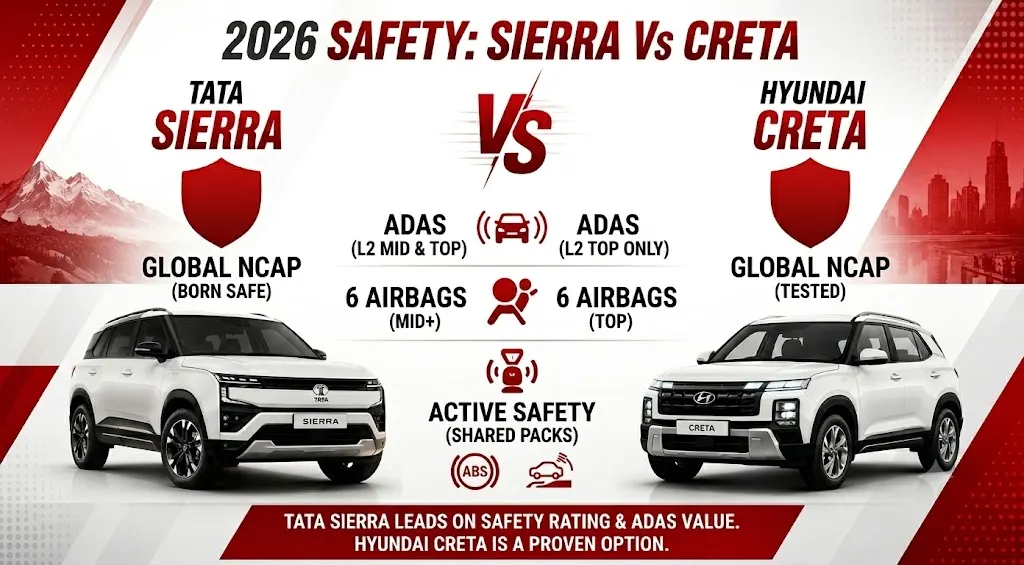
The Creta also comes with six airbags as standard, electronic stability control, hill-start assist control, a tire pressure monitoring system, and rear parking sensors across its range. Where it falls a little short of the Sierra is in how Hyundai has structured the 2026 lineup: Level 2 ADAS features, things like lane-keeping assist, forward collision warning, blind-spot monitoring, and adaptive cruise control with stop-and-go, are now reserved exclusively for the range-topping King variant. If you want that tech, you have no choice but to pay for the most expensive trim. As for crash test data, the current-generation Creta hasn’t been independently tested by Global NCAP or Bharat NCAP yet, though the earlier pre-facelift version had managed a three-star Global NCAP rating.
Thus, even though both cars meet basic safety requirements, the Sierra offers its safety package across all variants and has achieved a five-star rating in crash tests, whereas the Mondeo does not. This is an advantage of the Sierra because safety is a key priority for any car buyer.
Which One Should You Buy?
The decision between the Tata Sierra and the Hyundai Creta would depend on the buyer’s priorities. A buyer should select the Sierra if he is looking for a spacious interior, an attractive design, ADAS availability across all variants, and a 5-star crash test result. The Creta, however, can be considered by those who look for a vehicle with a relatively low initial cost, a good record of reliability and resale value, and other useful traits such as reclining rear seats. Thus, the Sierra will be the preferred choice for those who want something innovative, while the Creta is a tried-and-true choice.
FAQ
1. Which is cheaper, the Tata Sierra or the Hyundai Creta?
A. The Creta starts lower at around ₹10.79 lakh, while the Sierra starts at ₹11.49 lakh. At the top end, the Sierra tops out near ₹21.29 lakh, compared with the Creta’s roughly ₹19.95 lakh.
2. Which one gives better mileage?
A. They’re closely matched. The Sierra’s diesel manual is claimed at up to 21.26 kmpl, while the Creta’s best diesel and petrol variants land in a similar 17-21 kmpl range.
3. Which SUV is safer?
A. The Sierra already has a 5-star Bharat NCAP rating for both adult and child protection. The current Creta hasn’t been crash-tested yet, and its ADAS is locked to the top King trim only.
4. Does the Hyundai Creta get ADAS on lower variants?
A. No. After the 2026 lineup update, Level 2 ADAS is offered only on the range-topping King trim. The Sierra instead spreads ADAS across several mid and top variants.
5. Which one has more cabin space?
A. The Sierra is longer, wider, and rides on a longer wheelbase, which translates to more rear legroom. The Creta makes up for it with small comfort touches like a reclining rear seat.