

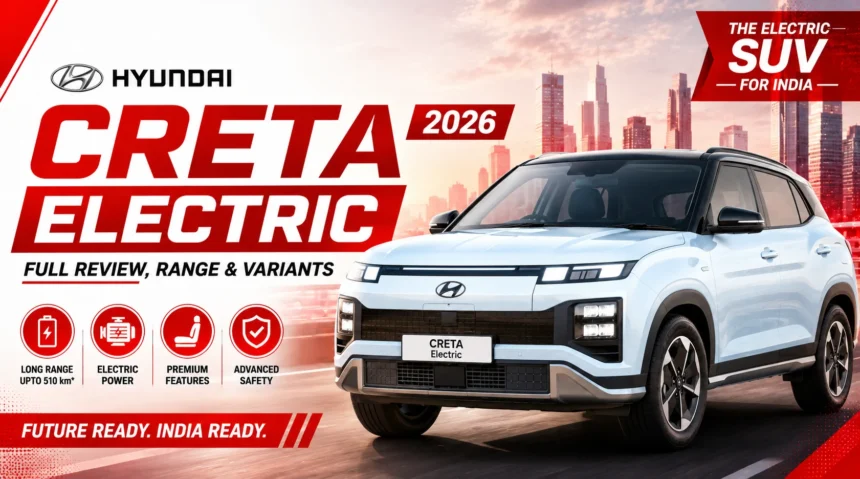
Ever wondered what it would take for India’s most loved SUV to go fully electric without losing the things that made it popular in the first place? That’s pretty much the question Hyundai set out to answer with the Creta Electric.
By 2026, it’s no longer just a quick EV experiment riding on a famous name. It has matured into a properly capable, no-compromise alternative to the petrol and diesel Creta. It looks familiar, drives smoothly, and comes loaded with tech that even some premium SUVs don’t get.
If you’re trying to decide whether it deserves a spot on your shortlist, here’s a complete, honest look at everything it brings to the table.
Hyundai Creta Electric 2026: Key Specifications
Numbers matter a lot when you’re shopping for an EV, so here’s a clean snapshot of what the Creta Electric brings to the table across both battery options.
| Specification | 42 kWh Variant | 51.4 kWh (Long Range) Variant |
| Battery Type | Lithium-ion (NMC) | Lithium-ion (NMC) |
| Motor Type | Permanent Magnet Synchronous Motor | Permanent Magnet Synchronous Motor |
| Max Power | 133 bhp | 169 bhp |
| Max Torque | 255 Nm | 255 Nm |
| Claimed Range | Up to 420 km | Up to 510 km |
| 0-100 kmph | Not officially disclosed | 7.9 seconds (claimed) |
| Top Speed | Not officially disclosed | 180 kmph |
| DC Fast Charging (10-80%) | Around 39 minutes (100 kW) | Around 39 minutes (100 kW) |
| AC Charging (10-100%) | Around 4 hours (11 kW) | Around 4 hours 50 minutes (11 kW) |
| Drive Type | FWD | FWD |
| Transmission | Single-speed Automatic | Single-speed Automatic |
| Dimensions (L x W x H) | 4340 x 1790 x 1655 mm | 4340 x 1790 x 1655 mm |
| Wheelbase | 2610 mm | 2610 mm |
| Ground Clearance | 190 mm | 190 mm |
| Boot Space | 433 litres | 433 litres |
| Seating Capacity | 5 | 5 |
| Wheels | 17-inch alloys | 17-inch alloys |
| Battery Warranty | 8 years / 1,60,000 km | 8 years / 1,60,000 km |
Price and Variants in India
Of course, when it comes to a topic like cars, money is the first thing everyone thinks about. The Hyundai Creta Electric is available in a price range of ₹18.02 lakh to ₹24.70 lakh, ex-showroom, as of June 2026. There has been a slight increase in Hyundai’s pricing for this model this month, ranging from ₹500 to ₹700, but you wouldn’t feel it in your EMI.
The options list seems daunting on paper, since this car is available in more than 30 variants from Hyundai, including a dual-color option and a home charging kit. But when you get past all the cosmetic options, only seven variants are worthy of being remembered.
| Variant | Battery Pack | Approx. Ex-Showroom Price |
| Executive | 42 kWh | ₹18.02 lakh |
| Executive Tech | 42 kWh | ₹19.00 lakh |
| Premium | 42 kWh | ₹20.00 lakh |
| Excellence | 42 kWh | ₹21.30 lakh |
| Executive (O) | 51.4 kWh | ₹20.00 lakh |
| Smart (O) | 51.4 kWh | ₹22.00 lakh onwards |
| Excellence LR | 51.4 kWh | ₹24.70 lakh |
In case you’re torn between the two variants, here’s something that may help you decide. Most customers prefer the Excellence 42 kWh as this comes with Level 2 ADAS, a sunroof, ventilated seats, and six airbags as standard. The only benefit of opting for the Excellence LR variant is its longer range of 510 km. However, considering that the on-road price of the car will definitely exceed the quoted amount due to RTO and Insurance costs, you may check the current prices at your nearest dealership.
Exterior Design: Familiar Yet Different
The design team at Hyundai was not really focused on making the Creta Electric resemble a car from some futuristic movie, and this is actually a good decision. At first glance, one can hardly distinguish it from a regular Creta, which is advantageous for the model, since the Creta’s image is well-established among Indian drivers. However, closer inspection reveals certain differences. Thus, the grille on the new crossover has been replaced with a cover since the internal combustion engine is no longer present; it features a pixelation pattern similar to that of the Ioniq 5’s grille.
You also get sleek LED headlamps, a connected LED light bar at the rear, and 17-inch aero alloy wheels wrapped in low-rolling-resistance tires that squeeze out a little extra range. Active air flaps behind the grille open and close automatically depending on how much cooling the battery and motor need, helping aerodynamics at higher speeds. Front and rear skid plates give it a rugged stance, and higher trims get a Knight Edition option that blacks out the badges, mirror caps, and skid plates for a sportier finish. You get around ten paint choices, including a few sharp dual-tone combinations with a black roof, so there’s no shortage of options if you like your SUV to stand out.
Interior and Cabin Features
As soon as you step inside, it seems that this car was done right and is more luxurious than expected for its price segment. For starters, the cabin offers dual 10.25-inch screens: one for the infotainment system and one as a digital driver’s interface. Thanks to the absence of the gearshift tunnel, there is also a wireless phone charger, extra cup holders, and plenty of space for personal items.
Higher versions of the model come with a voice-controlled panoramic roof, a ventilation system, an 8-way adjustable, memory-enabled driver’s seat, and a Bose 8-speaker audio system with decent sound quality. The dual-zone air conditioning system will ensure comfort in the front seats, while the second row will feature a flat floor, ample knee room, and individual climate-control vents. Cargo volume is 433 liters, which should provide enough space for several pieces of luggage plus some bags on top, and the 60/40 split folding rear seats offer extra cargo space when needed. Also worth noting is Vehicle-to-Load functionality, allowing you to charge your laptop or even camp equipment from your car’s battery.
Hyundai Creta Electric 2026 Features
The variant you choose also changes your feature list quite a bit. The base Executive trim already gets six airbags, hill descent control, all-four disc brakes, and a rear camera, which is a solid starting point on its own. Move up to the Excellence trims and you unlock Hyundai’s SmartSense Level 2 ADAS suite with more than twenty driver-assist features, a 360-degree surround camera, and blind-spot monitoring. It’s genuinely worth the extra spend if safety tech is high on your priority list, and in 2026, it probably should be.
Engine, Mileage and Powertrain
The Hyundai Creta Electric features a single electric motor at the front, coupled with a 42 kWh or 51.4 kWh battery pack. In both cases, the battery utilizes the NMC (nickel-manganese-cobalt) cell chemistry. Unlike rival lithium-iron-phosphate (LFP) batteries, NMC battery packs offer higher energy density, resulting in more mileage per battery. However, LFP batteries boast longer lifespans. The good news is that Hyundai offers its customers an impressive 8-year/1,60,000 km warranty on the battery. Like any other electric vehicle, the Creta Electric delivers instant torque and power, and the Long Range variant is rated at 169 bhp and 255 Nm.
There are three driving modes: Eco, Normal, and Sport, that adjust the Creta Electric’s throttle sensitivity, allowing drivers to optimize their driving for their current needs. Eco mode would be perfect for maximizing distance covered during long trips, while Sport mode gives faster acceleration. The vehicle also has a regenerative braking system with four settings and a special feature called i-Pedal mode, which allows one-pedal driving and causes the car to slow down progressively when drivers release the accelerator pedal.
With an OTA update, Hyundai increased the range to a maximum of 420 km with the smaller 42 kWh battery and 510 km with the bigger 51.4 kWh battery. In reality, drivers could get ranges of 300-330 km and 380-420 km under mixed city traffic conditions, respectively.
Safety Features
Another area where the Creta Electric excels is safety. Even the Executive version of the Creta Electric comes with six airbags, something not found on every other vehicle in this class. In addition to this, it has Electronic Stability Control, hill descent control, disc brakes on all four corners, Tyre Pressure Monitoring System, and ISOFIX child seat anchor points as well. Once you step up into the Excellence or Excellence Long Range trim versions, Hyundai adds its SmartSense Level 2 advanced driver assistance system, which comes with more than 20 functions, such as forward collision avoidance assist, lane keeping assist, blind spot collision warning, and intelligent cruise control that can stop the car and restart itself.
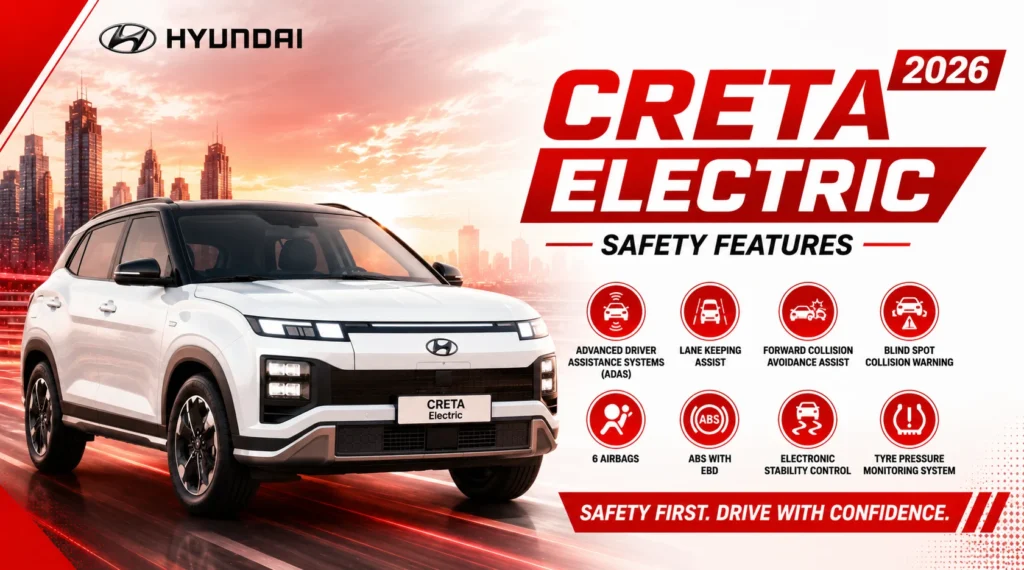
A 360-degree surround-view camera and a separate blind-spot view monitor round things off, both genuinely useful when you’re squeezing through tight Indian streets or parking lots. The Creta Electric hasn’t been independently crash-tested by Global NCAP or Bharat NCAP, so there’s no official star rating for this specific EV yet. The regular petrol Creta scored three stars in an older Global NCAP test, though Hyundai has reinforced the body structure on newer models, including this one, partly to protect the battery pack better in a collision. Going purely by the feature list, the Creta Electric still holds its own against most rivals in its price bracket.
Rivals: How Does It Stack Up?
The Creta Electric no longer has the segment to itself, and the competition is only getting tougher by the month. Here’s a quick look at how it compares with the other electric SUVs you’d likely cross-shop it with.
| Rival | Price Range (ex-showroom, approx) | Claimed Range |
| Tata Curvv EV | ₹17 lakh – ₹19.5 lakh | Up to 502 km |
| Mahindra BE 6 | ₹18.9 lakh – ₹26.9 lakh | Up to 682 km |
| MG Windsor EV | ₹12 lakh – ₹16.6 lakh | Up to 331 km |
| MG ZS EV | ₹18 lakh – ₹20.5 lakh | Up to 461 km |
| Maruti e Vitara | ₹15.99 lakh – ₹20 lakh | Up to 543 km |
The closest competitor to the Creta Electric must be the Tata Curvv EV, whose cost is similar to the Creta Electric’s, and whose shape is closer to a coupe-SUV than to a regular SUV. Another vehicle worth mentioning is the Mahindra BE 6, which boasts a more futuristic look and impressive range and performance, though it is significantly more expensive than the Creta Electric at any trim above the base model. Two other vehicles that could give the Creta Electric competition based on cost alone are the MG Windsor EV and MG ZS EV, which are cheaper than the Creta Electric, though they have a shorter range than the latter.
Final Verdict
Do you really need to go for the Hyundai Creta Electric when it does come out in 2026? When it comes to an EV which doesn’t force you to adjust yourself to a completely new way of driving, this is perhaps the most effortless recommendation available to you at this moment. It isn’t the cheapest offering in this list nor is it the most thrilling ride, but there is no doubt that the Creta checks off all the boxes – great range, luxurious interiors, excellent safety features on its top trims, and the backing of the Creta brand to boot.
FAQ
1. What is the price of the Hyundai Creta Electric in 2026?
A. It ranges from ₹18.02 lakh to ₹24.70 lakh, ex-showroom, depending on the variant and battery size you pick.
2. What is the real range of the Hyundai Creta Electric?
A. Hyundai claims up to 420 km on the 42 kWh battery and up to 510 km on the 51.4 kWh one, though expect 300-420 km in real daily driving.
3. How long does the Creta Electric take to charge?
A. On a 100 kW DC fast charger, it goes from 10-80% in about 39 minutes. A home AC charger takes around 4-5 hours to fully charge.
4. Is the Hyundai Creta Electric safe?
A. It comes with six airbags standard and Level 2 ADAS on higher trims, but it hasn’t been crash-tested by Global NCAP or Bharat NCAP yet.
5. Which Creta Electric variant offers the best value?
A. The Excellence 42 kWh is the sweet spot, giving you ADAS, a sunroof, and ventilated seats without paying extra for the long-range battery.