

If someone told you five years ago that a car called Tata Sierra would be competing neck-and-neck with the Kia Seltos, you probably would have laughed. Yet here we are in 2026, and that’s exactly what’s happening.
The Sierra is back, reborn, and very much ready to fight. Kia just launched an all-new second-generation Seltos that has more space, more tech, and more confidence than ever before.
So which one should you actually buy? Let’s break it down, section by section.
Tata Sierra vs Kia Seltos 2026: Key Specs
Here’s a quick look at how the two cars compare on key specs:
| Parameter | Tata Sierra | Kia Seltos |
| Price Range (Ex-showroom) | ₹11.49 – ₹21.29 lakh | ₹10.99 – ₹20.21 lakh |
| Length | 4,340 mm | 4,460 mm |
| Width | 1,841 mm | 1,830 mm |
| Height | 1,715 mm | 1,635 mm |
| Wheelbase | 2,650 mm | 2,690 mm |
| Ground Clearance | 205 mm | 200 mm |
| Boot Space | 622 litres | 433 litres |
| Seating Capacity | 5 | 5 |
| Infotainment Screen | Dual 12.3″ OLED (top variant) | Trinity Panoramic Display (dual 12.3″) |
| Instrument Cluster | 10.25″ digital | 12.3″ digital |
| Sunroof | Panoramic (1525mm x 925mm) | Dual-pane Panoramic |
| Sound System | 12-speaker JBL with Dolby Atmos | 8-speaker Bose |
| Airbags (Standard) | 6 | 6 |
| Level 2 ADAS | Yes (top variants) | Yes (top variants) |
| 360° Camera | Yes | Yes |
| Wireless Android Auto/Apple CarPlay | Yes | Yes |
| Connected Car Features | 75 (iRA App) | Multiple (Kia Connect) |
| 5G Connectivity | Yes (India’s first ICE car) | No |
| BNCAP Rating | 5 Star | 5 Star |
The Sierra clearly wins on boot space, 622 liters is massive and the best in the segment. The Kia Seltos wins on wheelbase, meaning rear passengers get slightly more legroom. The Sierra’s 5G connectivity is a genuine first in India for a petrol/diesel car and enables OTA updates for up to 10 ECUs, which is impressive for the price.
Price and Variants: How Do They Stack Up?
Both cars start at almost the exact same price, which makes the comparison even more interesting. Here’s a full breakdown of every variant and its price for both cars:
Tata Sierra: Variants & Prices (Ex-showroom)
| Variant | Engine | Transmission | Price |
| Smart Plus | 1.5L NA Petrol | 6MT | ₹11.49 lakh |
| Pure Plus | 1.5L NA Petrol | 6MT | ₹12.49 lakh |
| Pure Plus | 1.5L NA Petrol | 7DCT | ₹13.49 lakh |
| Adventure Plus | 1.5L NA Petrol | 6MT | ₹13.99 lakh |
| Adventure Plus | 1.5L NA Petrol | 7DCT | ₹14.99 lakh |
| Adventure Plus | 1.5L Turbo Petrol | 6AT | ₹15.49 lakh |
| Adventure Plus | 1.5L Diesel | 6MT | ₹15.99 lakh |
| Adventure Plus | 1.5L Diesel | 6AT | ₹16.99 lakh |
| Accomplished Plus | 1.5L NA Petrol | 6MT | ₹15.49 lakh |
| Accomplished Plus | 1.5L NA Petrol | 7DCT | ₹16.49 lakh |
| Accomplished Plus | 1.5L Turbo Petrol | 6AT | ₹16.99 lakh |
| Accomplished Plus | 1.5L Diesel | 6MT | ₹17.49 lakh |
| Accomplished Plus | 1.5L Diesel | 6AT | ₹18.49 lakh |
| Accomplished Plus Dark | 1.5L Turbo Petrol | 6AT | ₹17.49 lakh |
| Accomplished Plus Dark | 1.5L Diesel | 6AT | ₹18.99 lakh |
| Stealth Plus | 1.5L Turbo Petrol | 6AT | ₹18.49 lakh |
| Stealth Plus | 1.5L Diesel | 6MT | ₹18.99 lakh |
| Stealth Plus | 1.5L Diesel | 6AT | ₹19.99 lakh |
| Stealth Plus Dark | 1.5L Turbo Petrol | 6AT | ₹18.99 lakh |
| Stealth Plus Dark | 1.5L Diesel | 6AT | ₹20.49 lakh |
| Accomplished+ EV Edition | 1.5L Turbo Petrol | 6AT | ₹17.99 lakh |
| Top Diesel AT (flagship) | 1.5L Diesel | 6AT | ₹21.29 lakh |
Kia Seltos: Variants & Prices (Ex-showroom)
| Variant | Engine | Transmission | Price |
| HTE | 1.5L NA Petrol | 6MT | ₹10.99 lakh |
| HTE (O) | 1.5L NA Petrol | 6MT | ₹11.99 lakh |
| HTK | 1.5L NA Petrol | 6MT | ₹13.49 lakh |
| HTK (O) | 1.5L NA Petrol | 6MT | ₹14.49 lakh |
| HTX | 1.5L NA Petrol | 6MT | ₹15.49 lakh |
| HTX | 1.5L NA Petrol | IVT | ₹16.49 lakh |
| HTX | 1.5L Diesel | 6MT | ₹16.99 lakh |
| HTX (A) | 1.5L Turbo Petrol | 7DCT | ₹17.49 lakh |
| GTX | 1.5L Turbo Petrol | 6iMT | ₹17.99 lakh |
| GTX | 1.5L Diesel | 6MT | ₹17.99 lakh |
| X-Line | 1.5L Turbo Petrol | 6iMT | ₹18.39 lakh |
| X-Line | 1.5L Diesel | 6MT | ₹18.39 lakh |
| GTX (A) | 1.5L Turbo Petrol | 7DCT | ₹19.49 lakh |
| GTX (A) | 1.5L Diesel | 6AT | ₹19.49 lakh |
| X-Line (A) | 1.5L Turbo Petrol | 7DCT | ₹19.99 lakh |
| X-Line (A) | 1.5L Diesel | 6AT | ₹20.21 lakh |
The difference between the two starts around ₹50,000 on the lower end of the spectrum, where the Seltos comes in. However, at the upper end, the Sierra, with its diesel automatic version, is slightly better. The Sierra is also more detailed, with 24 variants compared to the Seltos’ 10. Both vehicles have good mid-level variants for most customers in the ₹13-17 lakh bracket.
Design and Comfort Difference Of Two Very Different Personalities
Tata Sierra
The Tata Sierra is boldly retro-modern. It is tall and boxy with a presence that will definitely make it stand out even in heavy traffic. The darkened roof, bulky C-pillar, and huge rear glass windows are a throwback to its 1991 predecessor. Flush door handles, slim LED headlamps, and an integrated LED strip mounted above the roof lend the car a futuristic touch. At a whopping 1,715 mm, the vehicle is taller than most of its competitors and delivers an authentic SUV experience. You are up high, have an eagle eye view of everything around you, and you feel like royalty sitting behind the wheel.
Inside, the Sierra’s cabin feels like someone tried to build a lounge on wheels. The triple-screen setup is a genuine conversation starter. One screen for the driver (10.25″ cluster), one central 12.3″ infotainment screen, and one 12.3″ screen for the front passenger. The JBL soundbar mounted on the dashboard is another unique touch. Soft-touch materials are used across the dashboard, and the leatherette seats feel genuinely premium. The 205mm ground clearance means you also handle bumps and broken roads with ease.
Kia Seltos
The Kia Seltos, on the other hand, has grown into a bolder, more muscular SUV. This new generation moved to a squarer, upright stance inspired by Kia’s flagship EV9. The Digital Tiger Face grille, ice-cube LED headlamps, and vertical DRL strips that wrap onto the bonnet make for a striking front end. The 18-inch crystal-cut alloys with neon brake calipers on GT-Line variants add a sporty, street-ready look. It’s lower than the Sierra at 1,635 mm, giving it a sportier, crossover-like feel from the outside.
Inside the Seltos, the Trinity Panoramic Display (two 12.3-inch screens combined into a single seamless panel) looks sharp and modern. The 64-color ambient lighting, dual-zone climate control, and ventilated front seats make the cabin feel premium. At 4,460 mm long with a 2,690 mm wheelbase, the Seltos is actually the longest car in its class: rear legroom is excellent, and the 433-liter boot (expandable with fold-flat seats) handles family luggage with ease.
Engine, Mileage, and Powertrain: How Do They Drive?
Both cars use 1.5-liter engines across all three fuel types, but the driving experience is quite different.
Tata Sierra Engines:
- 1.5L Naturally Aspirated Petrol: 106 hp, 145 Nm, paired with 6-speed manual or 7-speed DCT
- 1.5L Turbo Petrol: 160 hp, 255 Nm, paired with 6-speed Aisin automatic
- 1.5L Turbo Diesel: 118 hp, 260–280 Nm, paired with 6-speed manual or 6-speed automatic
The Sierra’s turbo-petrol is the pick of the lot. Reviewers praise its refinement and linear power delivery. The diesel is smooth and torquey, ideal for highway driving and those who clock high daily kilometers. The NA petrol is easy and predictable for city use. Claimed mileage ranges from 15.3 to 17.4 kmpl for petrol and 19.2 to 21.3 kmpl for diesel.
Kia Seltos Engines:
- 1.5L Naturally Aspirated Petrol: 113 hp, 144 Nm, paired with 6-speed manual or IVT (CVT-type)
- 1.5L Turbo Petrol: 158 hp, 253 Nm, paired with 6-speed iMT or 7-speed DCT
- 1.5L Turbo Diesel: 113 hp, 250 Nm, paired with 6-speed manual or 6-speed torque-converter automatic
The Seltos petrol engines are lighter and feel easier to manage in city traffic. The IVT (CVT-type) variant with the NA petrol is a brilliant choice for stop-and-go city driving, smooth, efficient, and low-stress. The turbo-petrol DCT combination makes the Seltos genuinely quick and responsive. The diesel is capable but slightly less powerful than the Sierra’s diesel on paper.
Regarding mileage, the two vehicles are equally matched. The actual mileage of the Seltos NA petrol model equipped with the IVT has been noted to perform better in the city, while the Sierra diesel model comes out better on the highway. When it comes to performance, the Sierra with its turbo-petrol engine has a slight edge in maximum power.
Safety Features Differences
First of all, even at the base variant, the Tata Sierra is safe. The vehicle comes with 6 airbags, ABS with EBD, Electronic Stability Control, traction control, hill-hold assist, all-disc brakes, TPMS, and a 360-degree camera. Higher trims include Level 2 ADAS such as Auto Emergency Braking, Lane Keeping Assist, Adaptive Cruise Control, and Cross Traffic Alert. Moreover, the Frequency-Dependent Damping in higher variants of the Sierra helps maintain stability over bumpy or rough terrain. Also, the Tata Sierra has achieved a 5-star NCAP rating, indicating a very strong body.
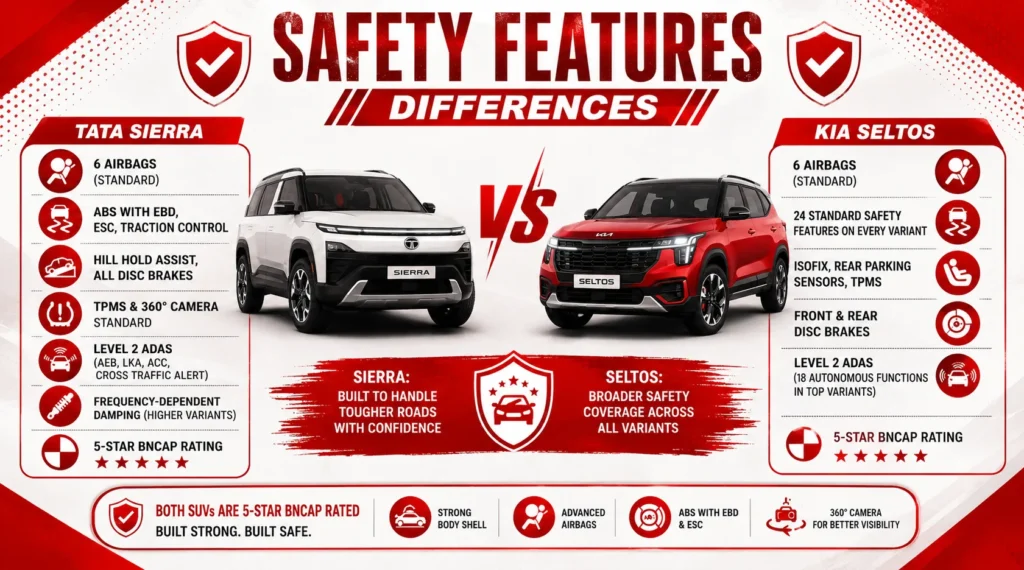
The Kia Seltos pays more attention to a wide range of safety features included. Every variant, starting with the base HTE, includes 24 core safety features such as ESC, ABS with EBD, traction control, TPMS, rear parking sensors, ISOFIX child seat anchors, and front and rear disc brakes. In turn, GTX+ and X-Line variants include Level 2 ADAS that provides 18 autonomous functions: Lane Departure Warning, Front Collision Warning, Driver Attention Warning, and Blind Spot Collision Warning. In addition, the Kia Seltos is a 5-star BNCAP-rated vehicle as well, as of March 2026. For families purchasing a mid-size vehicle, the Seltos is the safer choice.
Final Thoughts: Which One is Right for You?
There is no single correct answer here, and that’s actually a good thing. It means both cars are genuinely good choices.
Buy the Tata Sierra if: You want something that stands out visually, love the idea of an SUV with real height and presence, care about boot space (622 liters is outstanding), or want India’s most connected ICE car with 5G and OTA updates. The Sierra also makes more sense if you’re regularly driving on rough or semi-rural roads, thanks to its higher ground clearance of 205mm.
Buy the Kia Seltos if: You want a larger, more spacious cabin (especially for rear passengers), prefer smoother city driving with the IVT gearbox, want broader safety coverage even on lower variants, or simply want a car with a proven track record. The Kia Seltos crossed 6 lakh cumulative sales in India by early 2026, which says a lot about owner confidence.
Both start under ₹11.5 lakh, both top out around ₹20-21 lakh, and both offer three engine options with excellent technology. In 2026, you genuinely can’t go wrong with either. It really just comes down to what kind of driver you are.
FAQ
Q1. Which is better value for money: Tata Sierra or Kia Seltos 2026?
A. The Seltos starts ₹50,000 cheaper at ₹10.99 lakh and spreads more safety features across all variants, making lower trims feel more complete. The Sierra, starting at ₹11.49 lakh, gives you more boot space, a taller SUV stance, and India’s first 5G connectivity in an ICE car. If you’re buying in the ₹13-16 lakh range, the Seltos offers better all-round value. If you want something more distinctive and tech-forward, the Sierra justifies the slight premium.
Q2. Which car has better mileage: Tata Sierra or Kia Seltos?
A. The Sierra’s diesel manual claims up to 21.26 kmpl, while the Seltos diesel is slightly behind on paper. For petrol, the Seltos’ IVT (CVT-type) gearbox is noticeably more fuel-efficient in city driving than the Sierra’s turbo-petrol, which can struggle in heavy traffic. If you drive mostly in the city, the Seltos NA petrol with IVT is the smarter pick. For highway and long-distance driving, the Sierra diesel automatic is hard to beat.
Q3. Is the Tata Sierra safer than the Kia Seltos?
A. Both have earned a 5-star BNCAP rating, so structurally they’re equally strong. The difference is in how safety features are spread across variants. The Seltos offers 24 standard safety features on every single variant, including the base model. The Sierra’s advanced features like Level 2 ADAS are mostly reserved for higher trims. So if you’re buying a mid or base variant, the Seltos gives you broader safety coverage for the same or lower price.
Q4. Which car has a better interior, Tata Sierra or Kia Seltos?
A. The Sierra’s triple-screen setup with a dedicated co-passenger display, JBL soundbar, and Dolby Atmos audio is genuinely unique and feels more premium in top variants. The Seltos counters with its Trinity Panoramic Display, Bose audio, 64-color ambient lighting, and a longer wheelbase that gives rear passengers noticeably more legroom. For a tech-heavy, lounge-like feel, the Sierra wins. For practical, spacious everyday comfort, the Seltos is the better choice.
Q5. Which should a first-time SUV buyer choose between the two?
A. For a first-time buyer, the Kia Seltos is the easier and safer recommendation. It has a proven track record, with over 6 lakh units sold in India, which means better resale value, more service experience across dealerships, and a well-sorted driving experience. The IVT automatic is also one of the smoothest gearboxes to drive in bumper-to-bumper traffic. The Sierra is exciting and fresh, but as it’s newer, it’s still building its reputation for reliability. If you want peace of mind along with great features, start with the Seltos.