

If you’ve spent any time on the road lately, you don’t need a spreadsheet to tell you that something has shifted. The sheer volume of new plates on the road is staggering.
It feels like every second person you talk to is either researching a mid-size SUV or debating the merits of an EV home charging setup. But this isn’t just a random spike in spending.
It’s a total overhaul of what the Indian consumer thinks a “car” actually represents. Scroll down and read the articles to the end for the complete info.
6 Key Drivers And Trends For Car Buyers In India In 2026
We’ve moved past the era when a car was just a tool for getting from Point A to Point B without getting rained on. The car demand 2026 has become a statement of tech-savviness, a safety bubble for the family, and, quite frankly, a mobile gadget. I’ve been watching these trends unfold, and if you’re looking to jump into the market this year, the landscape is wildly different from what it was even three years ago.
1. The SUV Takeover: It’s Not a Trend, It’s the New Standard
Let’s talk about the elephant in the room- the SUV. Or, more accurately, the millions of them. There was a time, not too long ago, when SUVs were reserved for politicians or people who actually lived on farms. They were bulky, hard to park, and drank fuel like it was going out of style. Fast forward to today, and SUVs account for more than 50% of the entire passenger vehicle market. That’s a massive jump from less than 20% a decade ago. But why? Is it just because they look “cool”?
Not precisely. The harsh reality of Indian infrastructure is largely to blame. Driving in cities still requires avoiding pits and dodging monsoon floods, despite the huge highway projects we’ve witnessed. An SUV’s high ground clearance is peace of mind, not a luxury. You don’t constantly frown and fear if that speed breaker just ruined your oil pan when you’re seated high up. There’s also a psychological aspect. Having a “commanding” view makes you feel a little less scared by the buses and trucks in the chaotic Indian traffic. SUVs have essentially destroyed the sedan, from small “crossovers” that are really hatchbacks on stilts to huge three-row loads.
2. The Electric Leap: Breaking the “Range Anxiety” Barrier
For years, the conversation around Electric Vehicles (EVs) in India was stuck in a loop: “I’d buy one, but where would I charge it?” or “What if the battery dies in traffic?” In 2026, those excuses are starting to sound a bit dated. We’re looking at EV sales hitting a solid 3-4% of the total market share. That might sound small, but when you consider the sheer scale of India, that’s hundreds of thousands of cars. The growth rate is north of 40% year over year.
The real hero here isn’t just the cars themselves, but the infrastructure that supports them. We’ve finally crossed the 25,000-public-charging-station mark. More importantly, the type of people buying EVs has changed. It’s no longer just the wealthy tech enthusiasts. It’s the daily commuter who realized that spending ₹8,000 a month on petrol is ridiculous when they could spend ₹800 on electricity.
According to the latest car news, With government incentives like the FAME schemes still providing a bit of a cushion on the initial price, and the rise of local battery manufacturing, the “green” choice is finally becoming the “frugal” choice. If you’re a city traveler with a dedicated parking spot, buying a petrol car in 2026 almost feels like buying a Nokia in the age of the iPhone.
3. The “Premiumization” of Entry-Level Cars
This is perhaps the most fascinating shift. Historically, India was a “price-sensitive” market. We wanted the cheapest car with the best mileage. Period. But that’s dead. Today, even the entry-level segment is undergoing “premiumization.” People are moving away from the “base models.” They want the sunroof. They want the 10-inch touchscreen. They want the ambient lighting. We’re seeing buyers who, ten years ago, would have bought a mid-range hatchback, now stretching their budgets to buy a feature-loaded compact car.
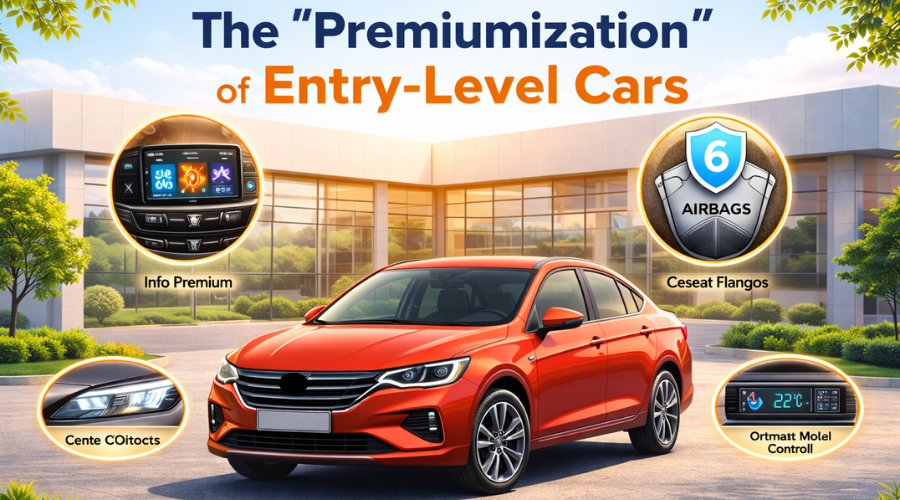
A car in India is a massive emotional investment. It’s often the second most expensive thing a person buys after a house. Because of that, the “bare-bones” car feels like a compromise people are no longer willing to make. Their car demand 2026 reflect their aspirations. This is why you see brands packing entry-level cars with ventilated seats and 360-degree cameras, features that were reserved for Mercedes and BMWs just a few years back.
4. Safety is Finally Selling
I remember when “safety” was a hard sell in Indian showrooms. Salespeople would talk about mileage and resale value, and if you asked about airbags, they’d shrug. That’s over. Thanks to a mix of stricter government regulations and a massive surge in consumer awareness (shoutout to Global NCAP ratings becoming a household topic), safety is now a top-three priority for buyers in this car sales trend. People are walking into showrooms and asking, “How many stars did this get?” before they even ask about the color options.
We’re seeing features like six airbags, Electronic Stability Control (ESC), and even ADAS (Advanced Driver Assistance Systems) trickling down to cars that cost under ₹15 Lakh. The idea that you have to be rich to be safe is a myth that 2026 has finally debunked.
5. The Hybrid Middle Ground
While everyone is talking about EVs, we can’t ignore the silent rise of Hybrids. For the person who does a 500km road trip every month, a pure EV can still be a bit stressful. Hybrids offer the “best of both worlds”, electric efficiency in crawl-speed city traffic and a petrol engine for the highway. It’s a pragmatic solution. You don’t need to plug it in, you don’t have to worry about the charger being broken at a highway rest stop, and you still get 25-28 km/l. As per the recent car news, for many Indian families, this is the “safe” transition step before going fully electric in 2030.
6. Financing: How Everyone Affords These Things?
You might wonder how, with car prices rising, sales are expected to cross 4.2 million units this year. The answer is simple: Financing is easier than it’s ever been. We’ve moved into a “subscription and EMI” culture. Banks are offering 7-year or even 8-year loans. Down payments are getting lower. Digital platforms allow you to get loan approval in minutes. Furthermore, the growth isn’t just coming from Delhi or Mumbai. It’s coming from “Tier 2” and “Tier 3” cities where aspirations are peaking, and road infrastructure is finally catching up.
Conclusion
The Indian car sales trend in 2026 is vibrant, chaotic, and incredibly tech-forward. It’s a reflection of a country that’s in a hurry to get somewhere, and we want to get there in comfort, safety, and style. Whatever you choose, just remember: the “best” car isn’t the one with the most features in the brochure; it’s the one that doesn’t make you regret the monthly payment when you see it sitting in your driveway.
FAQ
1. Why are SUVs so popular in India in 2026?
A. SUVs offer more space, higher ground clearance, and a strong road presence, making them ideal for Indian roads and family travel. With over 50% market share, they’ve become the default choice for many buyers like you.
2. Are electric vehicles (EVs) a practical option for daily use?
A. Yes, EVs are perfect for city driving due to their low running costs and growing charging infrastructure. With more affordable models available, they are now a practical and eco-friendly option for you.
3. What does the “premiumization” of entry-level cars mean for buyers?
A. It means that even budget cars now come with better design, modern features, and improved comfort. You can enjoy a more premium driving experience without significantly increasing your budget.
4. Should I consider a hybrid car instead of a petrol or electric vehicle?
A. Hybrids combine a petrol engine with an electric motor, offering better fuel efficiency without the need for charging. They are a smart choice if you want improved mileage but aren’t ready to switch fully to an EV.
5. How have financing options made car ownership easier in 2026?
A. Flexible loan options, lower down payments, and quick digital approvals have made buying a car more accessible. These benefits let you own a car sooner while comfortably managing your budget.