

Have you ever stopped to think about how fast India’s roads are changing? A few years ago, buying a car felt like a once-in-a-lifetime decision for most Indian families. Today, the story is very different.
India has already become the world’s third-largest automobile market, and if you look at where things are headed by 2026, it is hard not to feel genuinely excited. I want to walk you through what is happening in this industry: the numbers, the shifts, the policies.
Growth Projections To 2026
Let me start with the numbers because they tell a pretty remarkable story. India’s automobile industry was valued at around $250 billion in 2025. By 2026, it is expected to cross $300 billion. That is not a small jump. It represents millions of new vehicles, thousands of new jobs, and a complete reshaping of how India moves. In 2025 alone, India sold over 4.5 million passenger vehicles, crossing a historic milestone.
Two-wheeler sales, which have always been the backbone of Indian mobility, also bounced back strongly, crossing 20 million units. And electric vehicles? That segment is growing at nearly 90% year-on-year. In 2025, over 1.28 million electric two-wheelers were sold, which is a number nobody would have predicted even three years ago. By 2026, industry experts project that EV penetration in two-wheelers could reach 15–20%, and in passenger vehicles, around 5–8%. These might seem like modest numbers, but given where we started, they represent a complete transformation in how people think about buying and driving a vehicle in India.
Supply Chain Evolution
Here is something I find genuinely fascinating: the behind-the-scenes shift in the supply chain. For decades, India’s auto components industry depended heavily on imports of critical parts such as semiconductors, display units, and battery cells. The pandemic in 2020–21 exposed just how fragile that system was, when global chip shortages led to production halts across the country. Since then, there has been a deliberate push to build locally. The government’s Production Linked Incentive (PLI) scheme for auto components has committed ₹26,058 crore ($3.1 billion) to encourage local manufacturing of advanced automotive technology. This is already showing results. Companies like Sona BLW, Motherson Sumi, and Bosch India are significantly scaling up their local production.
India is also emerging as an important export hub. Auto component exports from India exceeded $22.9 billion in FY2025, with a target of $30 billion by 2026. Countries in Africa, Latin America, and Southeast Asia are increasingly sourcing parts from Indian manufacturers because of competitive pricing and improved quality. The shift from a “buy globally, assemble locally” model to a “make in India, sell globally” model is one of the most significant supply chain evolution stories of this decade.
India’s Automotive Industry Roadmap to 2026: Innovation
If you asked me what the single biggest change I see in this industry is, I would say it is the speed at which technology is moving from being a “nice to have” to being the entire product itself. India’s automakers are no longer just assembling cars. Companies like Tata Motors, Mahindra, and newer players like Ola Electric are building vehicles where software matters as much as the engine. Connected cars, vehicles that talk to your phone, track your driving patterns, and even update themselves like a smartphone, are becoming mainstream. Tata’s Nexon EV and Mahindra’s XEV 9e are clear examples of this shift.
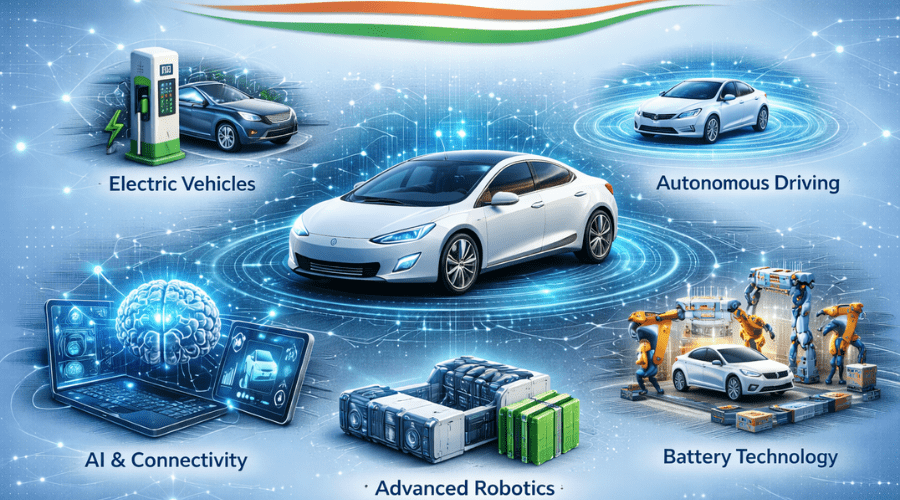
Battery technology is also improving fast. The cost of lithium-ion batteries has dropped by nearly 89% globally over the last decade, and Indian manufacturers are now investing in setting up their own battery cell plants to reduce dependence on imports. Ola Electric’s gigafactory in Tamil Nadu, which aims to produce 100 GWh of battery capacity annually, is one of the most ambitious bets in this space. Hydrogen fuel cell vehicles are still in their early stages in India, but Tata and KPIT Technologies have already been working on pilot projects, suggesting that 2026 might be the year we see the first serious hydrogen-powered commercial vehicles on Indian roads.
Growth Opportunities and Challenges
The growth opportunities are real and substantial. India’s rural market remains massively underpenetrated. With rising incomes and better road infrastructure under the PM Gati Shakti project, first-time vehicle buyers in Tier 2 and Tier 3 cities are becoming a huge growth driver. For EV charging infrastructure, India had around 27000-29000 public charging stations by the end of 2025. The government aims to scale this to 46,000 by 2026. Without that, consumer confidence in going electric simply will not grow fast enough.
But let me be honest about the challenges, too, because they are not small. Affordability remains the single biggest barrier. The average electric car in India still costs ₹12–20 lakh, which puts it out of reach for most buyers. Raw material costs, especially lithium, cobalt, and nickel, are volatile and mostly import-dependent. And while things are improving, the charging infrastructure in rural India is still years away from being reliable. Skilling is another real challenge. The shift to electric and connected vehicles means the industry needs a very different kind of workforce. People who understand software, battery management, and electronics. India is working on this through its National Automotive Testing and R&D and Innovation Center (NATRiP), but the gap between industry’s needs and what’s available remains wide.
Key Policies Supporting the Roadmap
You cannot talk about where this industry is going without discussing the policy backbone that holds it up. The government has been pretty serious about setting clear directions here. FAME II (Faster Adoption and Manufacturing of Electric Vehicles), with a budget of ₹10,000 crore, has been the cornerstone of EV adoption support, offering direct purchase subsidies on electric two-wheelers, three-wheelers, and buses. Its successor policy framework is expected to extend benefits through 2026.
The PLI scheme for Advanced Chemistry Cell (ACC) batteries, worth ₹18,100 crore, is directly aimed at building domestic battery manufacturing. It is a move that could reduce India’s dependence on Chinese EV imports over time. The Bharat NCAP crash test program is pushing automakers to raise safety standards, making Indian-made vehicles more competitive in global markets. This is not just good for safety, it is good for exports.
And the scrappage policy, which incentivizes the retirement of old, polluting vehicles, is quietly creating a replacement-demand cycle expected to drive 4–5 million additional vehicle sales through 2026. Taken together, I think these policies signal that India is not just reacting to global trends in the automotive industry. It is trying to lead in at least some of them. The road to 2026 will have its bumps, no doubt, but the direction is clear, the momentum is real, and for anyone watching this space, it is a genuinely exciting time to pay attention.
Final Words
India’s automotive journey to 2026 is not just about selling more cars. It is about building something much bigger. From homegrown EV technology to a stronger supply chain evolution, and smarter policies, the pieces are falling into place. Yes, challenges around affordability and infrastructure remain real. But if you look at the momentum, investment, startup activity, and the government’s push, it is clear that India is not following the global automotive revolution. It is actively shaping it. The best, I believe, is genuinely still ahead.
FAQ
1. What is India’s current rank in the global automobile market?
A. India is currently the third-largest automobile market in the world, having overtaken Japan in 2023, and is steadily moving toward becoming the second-largest by the end of this decade.
2. How many electric vehicles are being sold in India right now?
A. In 2023, India sold over 1.5 million electric two-wheelers and around 90,000 electric passenger cars. The EV segment is growing at nearly 90% year-on-year, making it one of the fastest-growing in the world.
3. What is the FAME II scheme, and how does it help buyers?
A. FAME II is a government program with a ₹10,000 crore budget that offers direct subsidies on electric two-wheelers, three-wheelers, and buses, making EVs more affordable for everyday buyers across India.
4. Is India manufacturing its own EV batteries?
A. Yes, India is working on it seriously. The government’s PLI scheme for Advanced Chemistry Cell batteries, worth ₹18,100 crore, is encouraging companies to build local battery production and reduce dependence on imports.
5. What is holding back faster EV adoption in India?
A. The biggest barriers are affordability, electric cars still cost ₹12–20 lakh on average, along with limited rural charging infrastructure and a shortage of skilled workers trained in EV and software-based vehicle technology.