
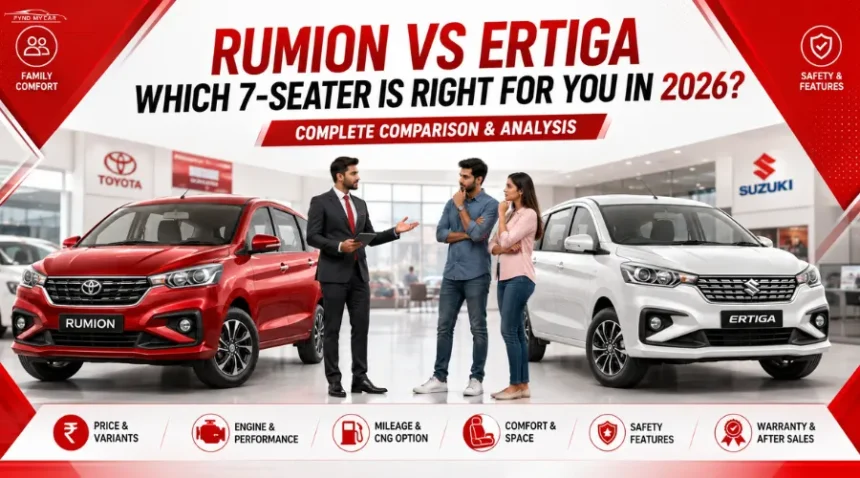
You are at the car dealership, and the salesperson is discussing both car models. And you just can’t decide which car you should go for. Sounds familiar? The Toyota Rumion and Maruti Suzuki Ertiga have been causing this dilemma among Indian families for some time now.
They look nearly identical, share the same engine, and sit in the same price ballpark. So what’s actually different? And more importantly, which one is worth your hard-earned money in 2026?
Go through this article and get the complete analysis regarding both these cars.
Toyota Rumion vs Maruti Ertiga 2026: A Quick Background
However, before going into the details, there’s one important fact most people won’t be aware of about the Toyota Rumion: it is just a rebranded version of the Maruti Suzuki Ertiga. Yes, indeed! Toyota and Suzuki have a joint venture in India, and the Toyota Rumion was produced through this collaboration. The Toyota Rumion is manufactured on the same platform and powered by the same engine as the Maruti Suzuki Ertiga from the same manufacturing plant. Now, if they are almost the same, what’s worth comparing then?
1. Price & Variants: Where Does Your Wallet Stand?
This is usually the first thing any buyer checks, so let’s start here. Maruti Suzuki Ertiga 2026 starts at just ₹8.80 lakh (ex-showroom) for the base LXi variant and goes up to ₹12.94 lakh for the top-end ZXi+ automatic. It comes in 4 main trims: LXi, VXi, ZXi, and ZXi+, with multiple petrol and CNG options spread across 9 variants in total. Toyota Rumion 2026 starts at ₹9.56 lakh (ex-showroom) for the newly launched base E variant and tops out at ₹13.86 lakh for the V AT. It’s available in 4 trims: E, S, G, and V, across 8 variants, with petrol manual, petrol automatic, and CNG options.
| Variant Level | Maruti Ertiga (ex-showroom) | Toyota Rumion (ex-showroom) |
| Base | ₹8.80 lakh (LXi MT) | ₹9.56 lakh (E MT) |
| Mid | ₹9.85 lakh (VXi MT) | ₹10.44 lakh (S MT) |
| Upper Mid | ₹11.20 lakh (ZXi MT) | ₹13.00 lakh (G AT) |
| Top | ₹12.94 lakh (ZXi+ AT) | ₹13.86 lakh (V AT) |
2. Specification Difference: What Do You Actually Get?
Scroll down and go through this table to get the complete details regarding the specifications of both these SUVs.
| Specification | Toyota Rumion | Maruti Suzuki Ertiga |
| Engine | 1.5L K15C Petrol | 1.5L K15C Petrol |
| Displacement | 1462 cc | 1462 cc |
| Power | 103 PS | ~102 PS |
| Torque | 137 Nm | 136 Nm |
| Transmission (MT) | 5-speed Manual | 5-speed Manual |
| Transmission (AT) | 6-speed Torque Converter | 6-speed Torque Converter |
| CNG Option | Yes (E variant only) | Yes (LXi & VXi) |
| Mileage (Petrol) | 20.11 kmpl | 20.51 kmpl |
| Mileage (CNG) | 26.11 km/kg | 26.08 km/kg |
| Length | 4420 mm | 4395 mm |
| Width | 1735 mm | 1735 mm |
| Height | 1690 mm | 1690 mm |
| Boot Space (3rd row up) | 209 litres | 209 litres |
| Boot Space (3rd row down) | 550 litres | 550 litres |
| Seating Capacity | 7 | 7 |
| Fuel Tank Capacity | 45 litres | 45 litres |
| Warranty | 3 years / unlimited km + extendable | 3 years / 1,00,000 km |
| NCAP Rating | Not tested | 1 star (Global NCAP 2024, older spec) |
| Colours Available | 5 | 6 |
3. Features Highlights
Both cars share many features across their mid- and top-tier variants. Things like a 7-inch touchscreen with wireless Apple CarPlay and Android Auto, rear AC vents, auto climate control, alloy wheels, and push-button start are common across the upper trims of both.
However, a few differences stand out:
- Warranty: This makes the biggest difference in practice. The Toyota brand offers 3 years of unlimited mileage coverage, with the option to extend the warranty for up to 5 years. While Maruti offers 3 years or 1,00,000 km, whichever comes earlier, in high-mileage cases, Toyota wins hands down.
- Suzuki Connect: The Ertiga comes with Maruti’s Suzuki Connect telematics system on higher variants, which offers features like emergency alerts, location tracking, and trip data via an app. The Rumion doesn’t offer an equivalent connected car system at the same level.
- TPMS (Tyre Pressure Monitoring System): The Rumion’s top V variant gets TPMS as standard, which the Ertiga doesn’t offer even at its top trim.
- Infotainment: Both have SmartPlay Pro+ units with wireless phone mirroring. The functionality is largely the same.
4. Design & Comfort: How Do They Look and Feel Inside?
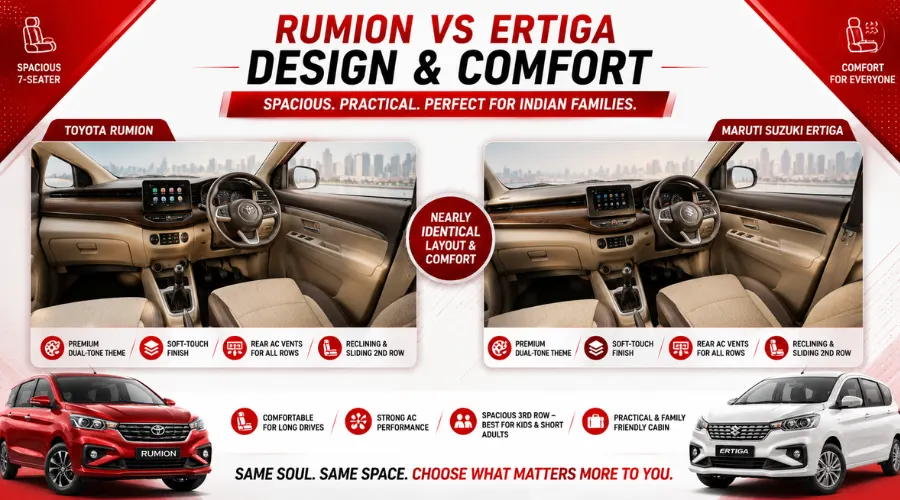
Let’s be honest. From the outside, these two cars are almost impossible to tell apart unless you’re standing right next to them. The basic silhouette, proportions, and even the windows are identical. The differences are limited to the front fascia and badging. The Rumion gets a slightly different front grille treatment with a more chrome-accented look to align with Toyota’s brand styling. The Suzuki Ertiga’s front is a bit more restrained and clean. At the rear, both look almost the same. The Ertiga has a slight edge with 6 color options compared to the Rumion’s 5. Ertiga’s Splendid Silver, Oxford Blue, and Pearl Arctic White are popular choices in India.
Walk into the interior, and the first thing you’ll observe is that the layout remains almost the same, with the dashboard contours, the same instrument panel, and the floating screen remaining identical. What sets Rumion apart, however, is its choice of materials and color combinations. Toyota has gone for slightly better-quality soft-touch plastics and a slightly different color combination in certain areas to make the Rumion’s cabin feel slightly more premium. The comfort level in both cases is good enough for Indian driving conditions. The second row can be reclined and slid backward, making it perfect for grandparents. The third-row seats will be comfortable only for children or small adults.
Ride quality is practically identical; both handle city potholes well, and the suspension is tuned more for comfort than sporty handling. Highway cruising is effortless in both. The AC performance on both is strong, and they both cool the cabin quickly, which is a huge deal in Indian summers. The rear roof-mounted AC vents (available from the VXi/G trim onwards) are genuinely useful for third-row passengers.
5. Engine, Mileage & Powertrain: Is There Any Difference at All?
This is where the Rumion vs Ertiga debate becomes simple. They use the exact same 1.5L K15C petrol engine. Same displacement, same power output, same gearbox options, same fuel efficiency.
Both offer:
- A 5-speed manual gearbox for the base and mid variants
- A 6-speed torque converter automatic with paddle shifters for the higher variants
- A factory-fitted CNG option on select base variants
The petrol engine produces around 103 PS and 137 Nm of torque. It’s not a performance engine by any means, but it’s smooth, refined, and perfectly suited for city commuting and family highway trips. The Ertiga uses Smart Hybrid Technology (mild hybrid) on all petrol variants. The same system is present under the hood in Rumion as well. This mild-hybrid system uses a small battery and an integrated starter generator to provide torque assist during acceleration and enable idle-stop start, contributing to the car’s fuel efficiency.
In real-world conditions, expect around 15–17 kmpl in city traffic and 18–20 kmpl on the highway from both cars. The CNG variant is a brilliant option for those clocking high daily kilometers, returning close to 26 km/kg on a claimed basis. There is literally no difference in the powertrain. You’re getting the same engine whether you buy the Ertiga or the Rumion. So if the engine is your deciding factor, flip a coin; both will treat you the same.
6. Safety Features: Where the Real Difference Lies
When it comes to safety, the story gets a little more complex and even more vital. In terms of airbags, both cars include 6 airbags as standard across all variants (an upgrade both companies introduced to their ranges in 2025). The new 6-airbag system includes the front, side, and curtain airbags.
Safety Features Comparison
The 1-star Global NCAP rating that is often associated with the Ertiga was obtained when the car had only dual airbags; that spec is no longer sold in India. The current 6-airbag models have not yet been independently crash-tested by Bharat NCAP or Global NCAP. Similarly, the Rumion has never been crash-tested. So both cars are currently in the same boat, untested under the latest standards, but better equipped than before. Here are the safety features provided in both cars.
| Safety Feature | Toyota Rumion | Maruti Suzuki Ertiga |
| Airbags (Standard) | 6 (all variants) | 6 (all variants) |
| ABS with EBD | Yes | Yes |
| Electronic Stability Control (ESC) | Yes | Yes |
| Hill Hold Assist | Yes | Yes |
| ISOFIX Child Seat Mounts | Yes | Yes |
| Rear Parking Sensors | Yes | Yes |
| Rear Parking Camera | Top variants | Top variants |
| TPMS | Top V variant only | Not available |
| Suzuki Connect (telematics) | No | Yes (higher variants) |
| Bharat NCAP / Global NCAP | Not tested | 1 star (older 2-airbag spec); updated model untested |
The Ertiga’s Suzuki Connect system does add an edge in emergency situations through its emergency call and SOS alert features. Toyota doesn’t offer a comparable connected safety feature on the Rumion. Overall, both cars offer a solid base of safety features for their price segment.
So, Which One Should You Buy?
Here’s the simple summary:
Choose the Maruti Suzuki Ertiga if:
- You want the lowest possible entry price
- You drive a lot and want the Suzuki Connect telematics and app-based features
- You want more variant and color choices
- You prefer a wider, more accessible service network across India
Choose the Toyota Rumion if:
- Warranty matters to you; Toyota’s unlimited km warranty is genuinely useful
- You want the peace of mind of the Toyota badge and dealership experience
- You’re buying the top variant and want TPMS as standard
- You travel long distances frequently and worry about post-warranty service costs
Both cars are great options as MPVs for families, and you’ll be satisfied with whichever choice you make for years to come. The Ertiga is the more affordable of the two, while offering more value for its size. However, the Rumion seems like the more reliable option.
FAQ
Q1. Is the Toyota Rumion the same car as the Maruti Suzuki Ertiga?
A. Nearly. The Rumion is just another name for an Ertiga; it’s basically built on the same design, engine, and plant. They vary in terms of grill style, branding, a bit of interior color, and how you own them. That’s about it.
Q2. Which is cheaper: the Rumion or the Ertiga?
A. Ertiga is available at around ₹75,000-₹1 lakh less compared to the Rumion. Ertiga is priced from ₹8.80 lakh, while Rumion is priced from ₹9.56 lakh. When choosing between the two cars based on price consideration, Ertiga is more economical.
Q3. Do both cars have the same mileage?
Q4. Which car has better safety features?
A. Both now come with 6 airbags as standard across all variants: dual front, side, and curtain airbags. Beyond that, both offer ABS with EBD, ESC, Hill Hold, and ISOFIX mounts. The Rumion edges ahead with TPMS on its top variant; the Ertiga counters with Suzuki Connect’s emergency and SOS alerts. Neither has been crash-tested under the latest NCAP protocols yet.
Q5. Why would anyone buy the Rumion over the cheaper Ertiga?
A. Mainly for the warranty. Toyota offers a higher standard warranty compared to Maruti, unlimited kilometers versus Maruti’s 1,00,000 km cap. For buyers who clock high mileage or simply want stronger post-purchase peace of mind, that Toyota badge and warranty package is worth the premium.