
Ever wondered why choosing a car in 2026 feels more complex than a fun weekend activity? With fuel prices playing hide-and-seek and hybrid technology finally going mainstream, the “petrol vs hybrid cars India” debate has moved from car magazines right into our living rooms.
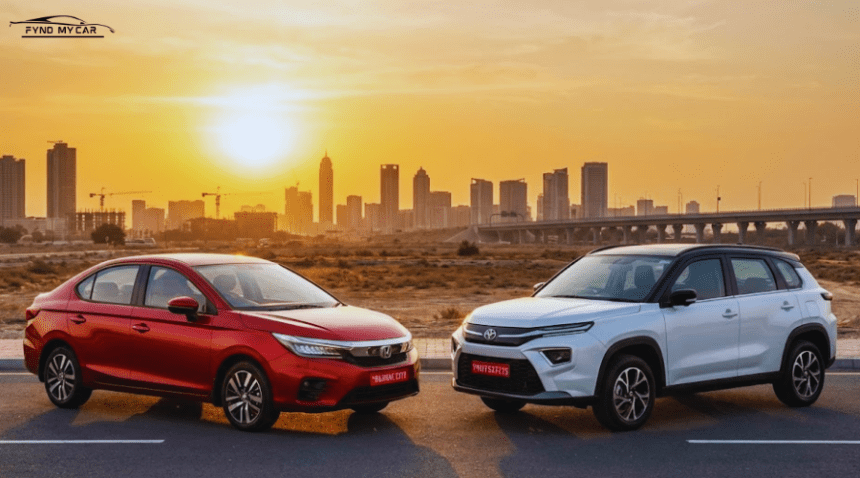
If you are standing at the crossroads between the timeless grace of the Honda City and the rugged, battery-backed muscle of the Toyota Hyryder, you aren’t alone. It is a choice between two very different lifestyles, and making the right call requires looking past the glossy brochures.
Key Specs of Honda City vs Toyota Hyryder
| Feature | Honda City (Petrol) | Toyota Hyryder (Strong Hybrid) |
| Engine | 1.5L i-VTEC (4-Cylinder) | 1.5L Atkinson Cycle + Electric Motor |
| Real-world Mileage | 15 kmpl | 27 kmpl |
| Transmission | 6-MT / CVT | e-CVT |
| Boot Space | 506 Litres (Huge) | 273 Litres (Small) |
| Ground Clearance | 165 mm | 210 mm |
| Best For | Driving pleasure & Comfort | Fuel savings & Bad roads |
The Great Price Divide: Sticker Price vs. Reality
By 2026, the price differential between a conventional petrol sedan and a strong hybrid SUV will have compressed, but it will remain significant. The Honda City continues as the benchmark in the Indian executive segment, with petrol variants priced between ₹13.5 and ₹17.5 lakh ex-showroom. For buyers seeking a premium experience without the added cost of hybridisation, the City remains the logical choice.
The Toyota Hyryder, however, plays a different game. While its mild-hybrid (standard petrol) versions start lower, the Strong Hybrid variants, the ones everyone actually wants, sit between ₹17 Lakh and ₹20.5 Lakh. You are essentially paying a premium of ₹3-4 lakh upfront for that Toyota hybrid badge. Thanks to the GST 2.0 reforms of late 2025, hybrids over 4 meters now carry a flat 40% tax, which has actually stabilised prices compared to the old, confusing cess system.
Features: Tech-Savvy vs. Traditional Luxury
The Toyota Hyryder positions itself as a technology-forward SUV. In 2026, it offers a panoramic sunroof, a 360-degree camera system that addresses urban parking challenges, and ventilated seats designed for high ambient temperatures. The inclusion of a Head-Up Display further reinforces its focus on advanced features.
The Honda City emphasises ergonomic design and material quality. While it omits certain headline features like a 360-degree camera, it compensates with superior seat comfort, high-grade materials, and a cabin layout that maximises usable space. Honda’s approach prioritises tactile feedback and long-term comfort over feature count.
Mileage and Powertrain: The Silent Battle
If we talk about hybrid vs petrol comparison, this is where the Hyryder usually lands its knockout punch. The Strong Hybrid system in the Toyota is nothing short of wizardry. In heavy city traffic, it runs mostly on its electric motor, delivering a mind-boggling 27-28 kmpl. If you drive 50km a day in a city like Mumbai or Bangalore, you might only visit the petrol pump once a month.
The Honda City’s 1.5L i-VTEC petrol engine remains a benchmark for naturally aspirated powertrains in India. It delivers a real-world efficiency of 14-16 kmpl and is recognised for its linear power delivery and driver engagement. While an e:HEV hybrid variant exists, the majority of buyers continue to prefer the petrol model for its direct driving dynamics. The Hyryder is the rational choice for fuel savings; the City is the enthusiast’s pick for driving experience.
Interior and Exterior: Elegance vs. Presence
The Honda City is the quintessential “white-collar” car. Its long, low-slung silhouette with those sharp LED “Jewel Eye” headlamps screams sophistication. It’s the car you want to be seen stepping out of at a wedding or a board meeting.
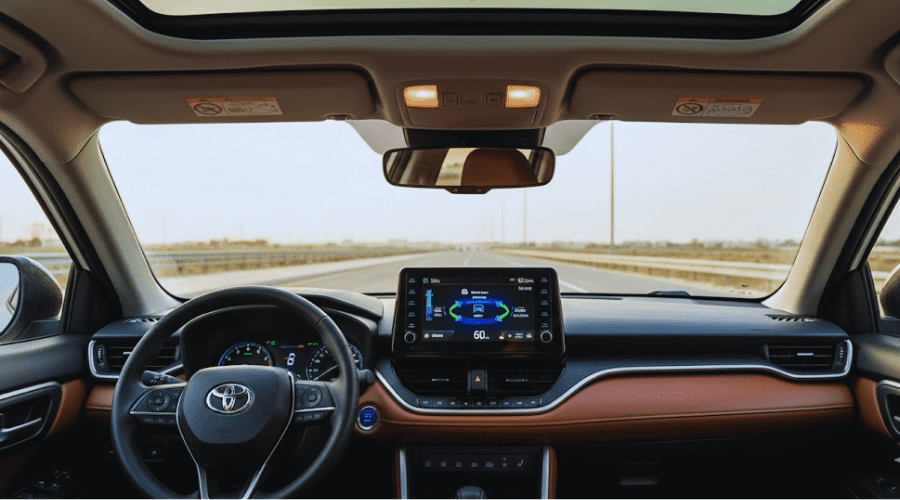
The Hyryder emphasises road presence with its elevated stance and SUV proportions, attributes that resonate strongly with Indian buyers. Ground clearance is generous, making it well-suited for urban and semi-urban conditions. However, the hybrid battery’s packaging reduces boot capacity to approximately 273 litres, a notable compromise compared to the City’s 506-litre trunk, which remains best-in-class for luggage space.
Safety: The “Five-Star” Promise
According to the latest automotive trends, both manufacturers have doubled down on safety for 2026. The Honda City comes with Honda Sensing, a suite of ADAS features like Adaptive Cruise Control and Lane Keep Assist, across more variants than ever. It has a solid history of 5-star ASEAN NCAP ratings.
The Hyryder isn’t far behind, offering 6 airbags, Vehicle Stability Control, and its own suite of safety tech. Built on a platform shared with the Grand Vitara (known for its robust TECT architecture), it feels incredibly planted on the highway. Both cars give you the peace of mind that your family is protected by modern high-tensile steel and smart electronics.
Battery Fear vs. Resale Reality
One of the biggest hurdles for Hybrid buyers is “Battery Anxiety.” What happens if the battery dies in 2031? According to data from the 2025 automotive trends reports, Toyota’s hybrid batteries are designed to last the life of the car, often coming with an 8-year/1,60,000 km warranty.
In terms of resale, the tide is turning. Historically, the Honda City held its value like gold. But in 2026, as petrol prices stay high, the demand for used hybrids is skyrocketing. A second-hand Hyryder Hybrid might actually fetch a better percentage of its value in five years than a pure petrol sedan, simply because the next buyer will also be looking to save on fuel.
Maintenance Costs: The Hidden Surprise
You might think a Hybrid is more expensive to maintain because it’s “complex.” Surprisingly, the opposite is often true. According to recent car news, the maintenance cost for the Hyryder Hybrid is roughly ₹2-3 per km. Because the electric motor handles a lot of the low-speed work, there is less wear and tear on the engine and brakes (thanks to regenerative braking).
The Honda City is also known as “bulletproof.” Honda’s service network is vast, and parts are affordable. For the petrol City, you can expect an average 5-year service cost of around ₹5,000–₹6,000 per year. Both cars are remarkably light on the pocket, but the Hybrid has a slight edge in long-term mechanical longevity.
Verdict: Which model delivers the optimal value?
If you are trying to decide which car, petrol vs hybrid cars India, deserves your hard-earned money in 2026, the answer depends on your “choices” in life.
Choose the Toyota Hyryder if: You drive more than 40km a day in city traffic. The fuel savings will pay back the “Hybrid Premium” within 3-4 years, and the high ground clearance will save you from the stress of broken monsoon roads. It is the practical, future-ready choice for the modern Indian family.
Choose the Honda City if: You value the “soul” of a car. If you spend your weekends on the highway and love the feeling of a car that hugs the corners, the City remains the undisputed king. It offers more interior room, a much larger boot, and a level of timeless class that an SUV simply cannot match.
Ultimately, both models address distinct buyer priorities. The Hyryder optimises cost of ownership, while the City delivers a more engaging driving experience.
FAQ
1. Does the Hyryder’s battery need to be plugged in to charge?
A. No, the Toyota Hyryder is a “Self-Charging” Hybrid. It charges its battery using the petrol engine and by capturing energy that would otherwise be lost during braking.
2. Is the Honda City petrol being phased out?
A. Not at all. While Honda is pushing their e:HEV hybrid, the 1.5L i-VTEC remains a bestseller in 2026 due to its reliability and lower entry price.
3. Will the Hyryder’s small boot be a problem for airport runs?
A. It can be. While it fits 2-3 medium suitcases, the battery takes up significant floor space. If you travel with a lot of luggage, the Honda City is a safer bet.
4. How long does the Hybrid battery actually last?
A. Most experts and manufacturer data suggest these batteries easily last 10-12 years. Toyota also provides a generous 8-year warranty to ease any concerns.
5. Which car has better resale value in 2026?
A. Based on latest automotive trend, the Hyryder Hybrid is seeing higher demand in the used car market due to the rising cost of petrol, though the City remains a very stable second.