

Have you ever stood at a fuel station, watching the meter run faster than you thought, and wondered if there’s a smarter way to spend your money on fuel? I’ve been there too, and if you drive regularly, this question probably hits you often.
In 2026, fuel prices aren’t getting any kinder, and choosing between petrol and CNG isn’t just about your car anymore. It’s about your monthly budget. So let’s sit down and figure this out together in a simple way that actually helps you make a decision.
Fuel Price Difference in 2026
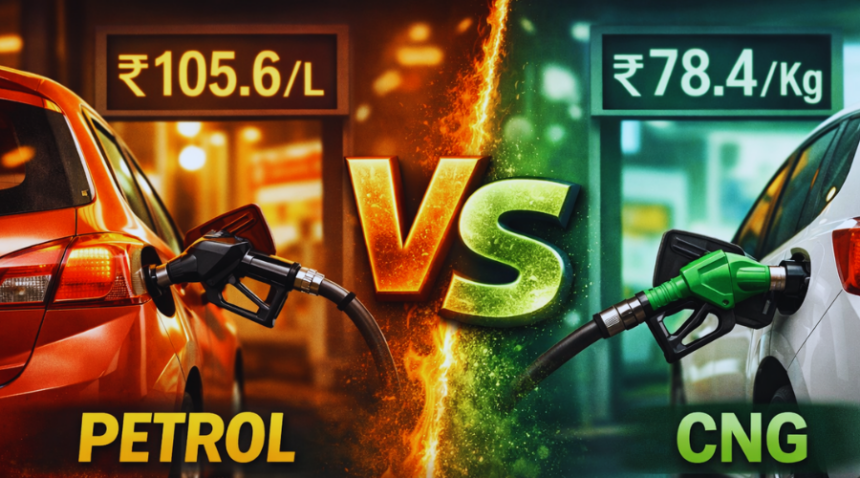
If we start with the basics, petrol is still clearly more expensive than the best CNG cars in India in 2026. Looking at current trends, petrol prices usually range from ₹95 to ₹110 per litre in many cities, while CNG is generally priced between ₹75 and ₹90 per kg. At first glance, you might think the difference isn’t huge. I used to feel the same. But the reality hits when you consider how far each fuel actually takes your car. CNG doesn’t just cost less, it also lasts longer for the same distance, which quietly increases your savings every time you drive.
Cost Per Kilometre (The Real Truth)
Now this is where things get really interesting, and honestly, this is the part that changed my perspective. Instead of looking at price per litre or kg, it makes more sense to look at cost per kilometre. With the best Petrol cars in India, you usually spend around ₹6 to ₹8 per kilometre, depending on your car and driving style. But with CNG, that cost drops to somewhere between ₹2.5 and ₹4 per kilometre. When I first did this math, it surprised me. It basically means that for the same distance, CNG can cost about half as much as petrol. Over time, this difference doesn’t just sit quietly; it builds into serious money.
Monthly and Yearly Savings
Let’s make this more personal. Imagine you and I both drive around 30 kilometres a day, which is pretty common for office travel. If you’re using petrol, your monthly fuel expense can easily reach ₹8,000-₹9,000. But with CNG, that same usage might cost you only ₹3,500-₹4,000. That’s a saving of around ₹4,000 to ₹5,000 every single month. When I think about it yearly, it becomes even more real. You could save ₹50,000 or more in a year. That’s not a small number; it’s something you can actually feel in your bank account.
Mileage: How Far Your Car Takes You?
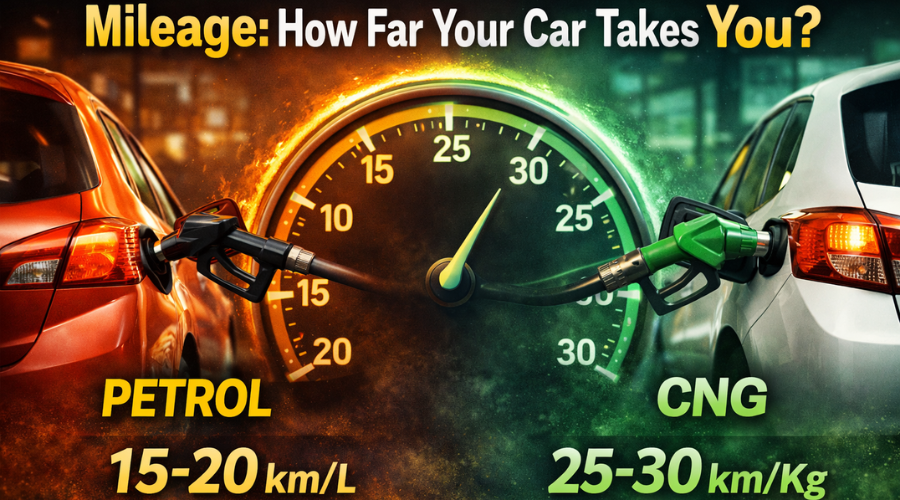
Mileage plays a huge role in all of this, even if we don’t always think about it directly. As per the car news India, Petrol cars usually give you around 15 to 20 kilometres per litre. On the other hand, CNG cars can achieve 25-30 km/kg. So when you combine better mileage with lower fuel cost, the advantage clearly leans towards CNG. This is exactly why people who drive a lot every day, such as cab drivers and daily commuters, often switch to CNG. It simply helps them stretch their fuel budget much further without changing their routine.
Initial Cost: The Catch You Should Know
Of course, nothing comes without a trade-off, and I want to be completely honest with you here. The best CNG cars in India usually cost more up front. You might end up paying an extra ₹80,000 to ₹1 lakh compared to the petrol version of the same car. I know that it can feel like a big jump at the time of purchase. But when you look at the savings we just discussed, that extra cost can often be recovered within 1 to 2 years. After that, whatever you save is essentially extra money staying in your pocket. So it’s more like an investment than an expense.
Daily Convenience: Where Petrol Still Wins
Now let’s talk about something practical, your everyday experience. This is where petrol still has an advantage. Petrol pumps are everywhere, and refilling takes just a few minutes. It’s quick and hassle-free. With CNG, things can be a bit different. Depending on where you live, you might have fewer CNG stations nearby, and sometimes there can be waiting lines, especially during busy hours. I’ve seen people spend a good amount of time just waiting to refill. So if convenience and time are your top priorities, petrol does feel easier to live with.
Long-Term Savings: Who Actually Wins?
If we focus purely on long-term savings, CNG clearly comes out ahead. Over time, you could save 40% to 60% on fuel costs compared to petrol. When you stretch that over a few years, the total savings can easily reach ₹2 to ₹3 lakh or even more, depending on how much you drive. When I look at it this way, it’s not just about saving a few rupees here and there; it’s about making a decision that has a real financial impact over time.
Who Should Choose Petrol?
The best Petrol cars in India still make sense for certain people, and you might be one of them. If you don’t drive much, or if your usage is mostly occasional, the savings from CNG might not feel significant enough to justify the higher initial cost. Also, if you prefer a smooth, quick, and stress-free refuelling experience, petrol is a better option. It’s simple, widely available, and doesn’t require you to plan your fuel stops too much.
Who Should Choose CNG?
CNG, on the other hand, is ideal if you’re someone who drives daily or covers long distances regularly. If you’re looking to cut down your monthly expenses and don’t mind a little extra effort at the pump, CNG can be a smart choice. It’s especially beneficial if you plan to keep your car for several years because that’s where the real savings start to show. For someone focused on long-term financial benefits, CNG often feels like the more practical option.
My Honest Take (From One Driver to Another)
If I had to explain this in the simplest way, I’d say this: you’re choosing between comfort today and savings tomorrow. Petrol gives you ease and speed in your daily routine, while CNG rewards you with lower expenses over time. According to the car news India, neither choice is wrong; it just depends on what matters more to you. I personally find that once you start noticing how much you’re saving with CNG, it becomes hard to go back.
Summing Up
At the end of the day, if your main goal is to save money, CNG is the clear winner in 2026. It offers lower cost per kilometre, better mileage, and significant savings over months and years. Petrol still holds its place for convenience and ease of use, but it simply doesn’t compete on cost. So the decision really comes down to your lifestyle. If you value comfort and simplicity, petrol works just fine. But if you’re looking to reduce your expenses and make a smarter financial choice, CNG is hard to ignore.
FAQ
1. Is CNG really cheaper than petrol in 2026?
A. Yes, CNG is still significantly cheaper than petrol in 2026. Not only is the price per kg lower, but CNG also gives better mileage. When you combine both factors, you end up spending almost half as much per kilometre as with petrol. So if saving money is your goal, CNG clearly has the advantage.
2. How much money can I actually save by switching to CNG?
A. From what I’ve seen and calculated, you can easily save around ₹4,000 to ₹5,000 per month if you drive daily. Over a year, that amounts to roughly ₹50,000 or more. The exact amount depends on how much you drive, but either way, the savings are noticeable and add up quickly.
3. Is the higher cost of a CNG car worth it?
A. At first, it might feel like you’re paying too much because CNG cars are usually ₹80,000 to ₹1 lakh more expensive than petrol ones. But the fuel savings help you recover that extra cost within 1-2 years. After that, you’re actually saving money every month, which makes it worth it in the long run.
4. Are there any disadvantages to using CNG?
A. Yes, there are a few things you should be aware of. CNG stations are not as widely available as petrol pumps in some areas, and you might face waiting lines. Also, refuelling takes a bit more time. So while you save money, you may need a little extra patience and planning.
5. Which is better for daily use, petrol or CNG?
A. If you drive daily or cover long distances, CNG is usually the better choice because of the savings. But if your driving is occasional and you prefer convenience without worrying about station availability, petrol might suit you better. It really depends on your routine and priorities.