
What if the fuel you’ve been putting in your car for years suddenly changed overnight, and nobody handed you a memo about it? That’s basically what happened across India.
Petrol stations have discontinued the sale of E10 as of April 1, 2026, and now sell E20 fuel only. If your vehicle seems to be acting up or you are wondering what E10 and E20 really are, you are not alone.
What Exactly Is E20 Fuel Anyway?
Here’s the simple version: E20 is regular petrol mixed with 20% ethanol, while E10 (the fuel most of us grew up using) had only 10% ethanol blended in. Ethanol itself is a plant-based alcohol, produced by fermentation from sugarcane, maize, damaged food grains, and similar crops. Yes, the same basic process that makes beer.
India did not directly move to E20. India moved from E5 way back in 2003, then to E10 until 2022, and now finally moved to E20. However, the surprising thing is that this phase-wise introduction of ethanol was initially scheduled for 2030, but the government accelerated it by almost five years.
Why Did the Government Rush This Change?
It’s not just about being eco-friendly, even though that’s part of the story. Here’s what’s actually driving the push:
- Cuts oil imports: India imports over 85% of its crude oil. Every drop of ethanol blended into petrol is one less drop of foreign oil the country needs to buy.
- Saves foreign exchange: Less imported oil means real money saved at the national level.
- Helps farmers: Sugarcane and maize growers get an additional income stream from ethanol production.
- Lowers emissions: The government claims E20 can cut CO2 emissions by roughly 20% compared to pure petrol, though some experts still debate this once you factor in the full lifecycle of ethanol production.
- Higher octane: E20 carries a minimum RON of 95, up from E10’s 91, which on paper means better anti-knock performance and smoother combustion.
Will E20 Actually Hurt Your Car’s Mileage?
This is the question everyone’s asking, and honestly, the answer isn’t a flat yes or no. Ethanol simply contains less energy per liter than pure petrol, around 34% less, to be precise. Do the math, and that suggests a theoretical efficiency loss of about 6-7% when running on E20.
But here comes the twist. Since E20 has a higher octane rating, it enables modern engines to burn it slightly better, making up for the lost efficiency. For cars designed for E20, real-world tests indicate that the mileage reduction is not as great as it would theoretically be – it is usually around 2-4%. In addition, even the Indian government admitted the possibility of mileage reduction by 3-5%.
However, some people claim the situation is worse than officially announced. According to a survey conducted by the LocalCircles network, as much as 80% of people driving cars manufactured before 2023 reported noticing a reduction in mileage, with 66% saying it exceeded 10%.
Is Your Car Even Built to Handle E20?
This is really the question that matters most, and the answer depends almost entirely on one thing: when your vehicle was manufactured. If your car or bike rolled out of the factory from April 2023 onwards, you’re in good shape. These vehicles fall under BS6 Phase 2 norms and are legally required to be E20-compliant, meaning they have ethanol-resistant fuel lines, seals, gaskets, O-rings, and an ECU specifically calibrated to handle the higher ethanol content.
Those vehicles manufactured from 2020 to 2022, when BS6 was in effect, are usually considered compatible, materials-wise, even if their engines were not calibrated to use ethanol. However, this gets complicated for vehicles manufactured before that time. Those cars produced from 2012 to 2023 were mostly designed for use with E10 fuel, while older BS3 or BS4 cars could only use E5/E10 fuels. Quick cheat sheet by production year:
| Manufacture Year | E20 Status | What You Should Do |
| April 2023 onwards | Fully E20 compliant by law | Fill up as usual, no worries |
| 2020 – 2022 (BS6 era) | Materially compatible | Fine, but keep an eye on mileage |
| 2012 – 2019 | Built for E10, not E20 | Get fuel system inspected periodically |
| Before 2012 (BS3/BS4) | Not designed beyond E5/E10 | Inspect rubber and fuel components regularly |
Some manufacturers have been surprisingly transparent about this:
- Honda says its cars and two-wheelers have been materially compatible with E20 since way back in 2009.
- Skoda has confirmed that all its BS6-era cars won’t run into warranty issues with E20 fuel.
- Maruti Suzuki, which sells more cars in India than any other automaker, has published a model-wise compatibility list. It flags models such as the pre-facelift Alto, older WagonR variants, and pre-2019 Swift and Baleno as E10-only, recommending inspection of rubber fuel components before extended E20 use.
What About Warranty: Will Using E20 Void It?
That’s where most of the worries come in, and rightly so. The Society of Indian Automobile Manufacturers, or SIAM, has made it clear that the warranties of older vehicles using E20 fuel are covered irrespective of what might be written in the owner’s manual. Now, this looks promising on paper, but there’s a catch here. Some manufacturers have not been very vocal about this fact and have not committed to providing a warranty for any engine damage resulting from non-compliance with E20 fuel use.
Are Two-Wheelers More at Risk Than Cars?
Yes, that is a point which is usually overlooked. Two-wheelers in India have a very large base and are relatively old, and they require much higher rubber and polymer content than cars for the same amount of engine power. As ethanol is hygroscopic, it can cause corrosion in metal tanks and wear on rubber gaskets. Older two-wheelers that have been operating on E10 have been reported to have problems with worn carburetor jets and fuel filter blockages. If you own an old two-wheeler, checking fuel system parts should be on your mind.
Can You Still Buy Pure Petrol or E10 Anywhere?
Technically, yes, but it’ll cost you. With E10 and plain petrol pulled from general retail, the only ethanol-free alternative is specialty fuel, options like IOC’s XP100, BPCL’s Speed 100, and HPCL’s Power100. These are priced significantly higher, around Rs. 160 per liter, and aren’t available at every pump. For most owners of older, non-compliant vehicles, this isn’t really a practical everyday solution; it’s more of an occasional workaround.
E20 vs E10 Fuel: What’s Actually Different Under the Hood?
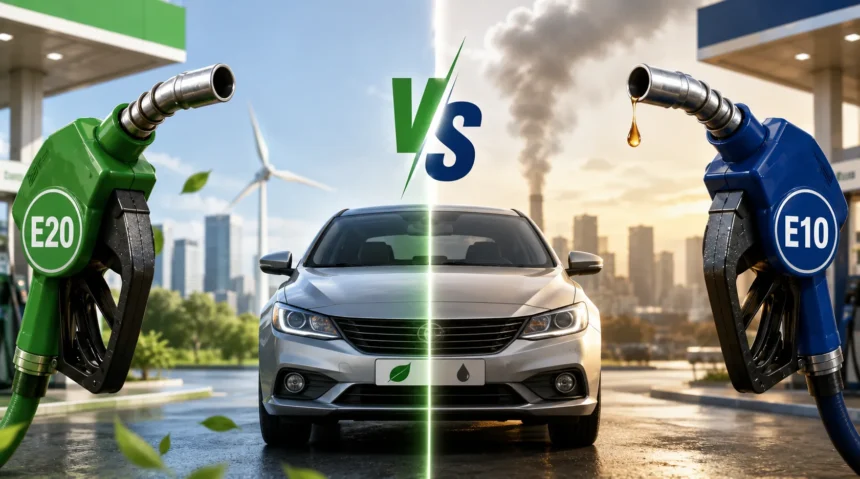
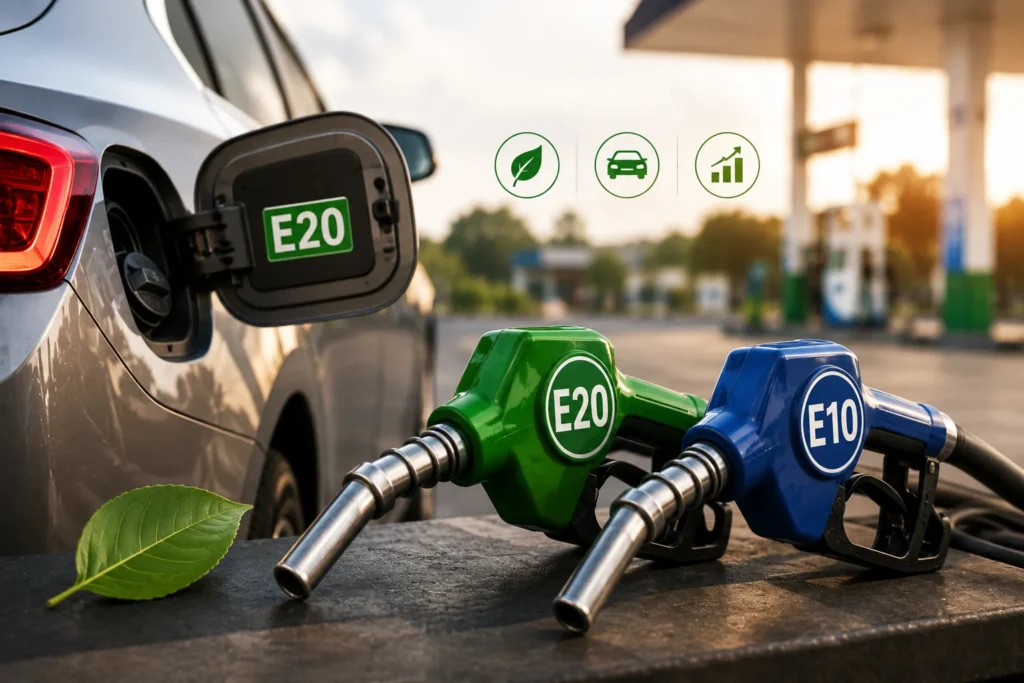
Let’s put the two side by side, because the differences aren’t just about the ethanol percentage.
| Factor | E10 | E20 |
| Blend ratio | 90% petrol + 10% ethanol | 80% petrol + 20% ethanol |
| Octane rating (RON) | 91 minimum | 95 minimum |
| Energy content | Higher than E20 | Slightly lower, due to more ethanol |
| Mileage impact | Baseline / no major change | 2-7% drop, depending on vehicle |
| Moisture absorption | Lower | Higher (ethanol attracts water) |
| Material needs | Runs fine in most older engines | Needs ethanol-resistant seals, hoses, and ECU tuning |
| Availability today | Withdrawn from pumps nationwide | Only blended petrol sold at retail outlets |
| Best suited for | Pre-2020 vehicles | Vehicles made from April 2023 onwards |
In short, E20 isn’t just “a bit more ethanol.” It’s a fuel that asks more of your engine, rewards newer technology, and is a little less forgiving toward older components.
What Should You Actually Do Right Now?
Here’s a simple checklist to follow:
- Check your manufacture date: If it’s April 2023 or later, just fill it up as usual.
- Visit a service center if your car is older: Get fuel hoses, seals, and gaskets inspected.
- Track your mileage: A small dip (2-5%) is normal; a sharp, sudden drop needs a mechanic’s attention.
- Look up your model online: Manufacturers like Maruti Suzuki, Honda, and Skoda have published compatibility lists.
- Keep service records handy: This helps if you ever need to raise a warranty claim.
There’s also an ongoing political and consumer debate here. The Opposition has pointed out that nearly 30 crore vehicles on Indian roads weren’t originally designed for E20, and there have been demands for compensation or, at least, continued E10 availability. The government’s counterargument is largely logistical: running three separate fuel grades across more than 1 lakh retail outlets nationwide simply isn’t feasible.
The Bottom Line
E20 is not going away anytime soon, and the truth is, it’s not as bad as it seems. If you have a new car, the transition is easy and comes with plenty of benefits. However, if you are driving an older car, you will need to be careful and cautious. Make sure your car meets all the necessary requirements, monitor your mileage, and don’t forget to inspect your fuel system. In 5 minutes, you can save yourself a lot of money in the future.
FAQs
1. What is the main difference between E10 and E20 fuel?
A. E10 is petrol with 10% ethanol. E20 has 20% ethanol. E20 also has a higher octane number, but it holds slightly less energy per liter.
2. Will E20 damage my car’s engine?
A. Not right away. Most cars, especially ones made after 2020, handle E20 fine. Older cars may show gradual wear on rubber parts over time, rather than sudden damage.
3. Does E20 fuel reduce mileage?
A. Yes, a little. Most cars see a 2-5% drop. Some older, non-compliant cars have reported bigger drops of over 10%.
4. Can I still buy plain petrol or E10 in India?
A. Not at regular pumps. Only costly ethanol-free fuels like XP100 or Power100 are sold now, and only at select outlets.
5. How do I know if my car is E20 compliant?
A. Check your owner’s manual or your car manufacturer’s website. Cars made from April 2023 onwards are E20 compliant by law.