
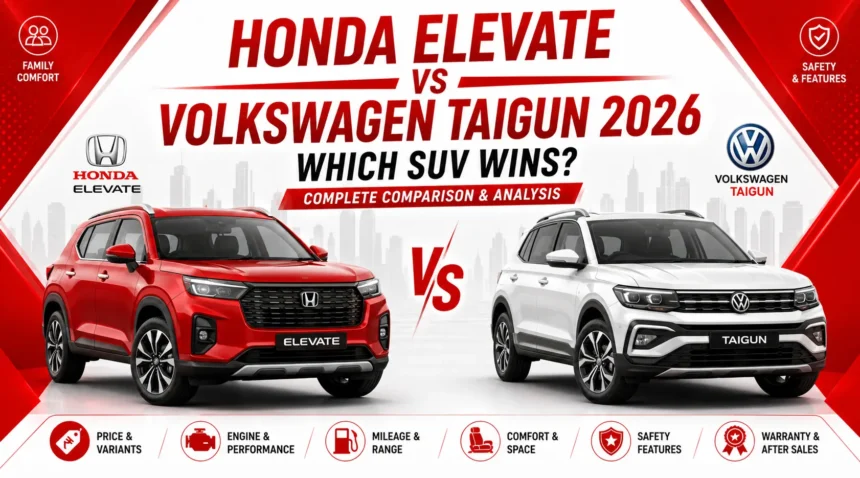
So you’ve shortlisted two of the most talked-about compact SUVs in India right now: the Honda Elevate vs Volkswagen Taigun, and you just cannot make up your mind. Trust me, you are not alone.
These cars are similarly priced and come from reliable brands. They both look good too. But under the surface, they differ greatly. Your choice should match what you need from a daily driver.
Let’s break it down properly and analyze everything you need to know before you walk into a showroom.
Honda Elevate vs Volkswagen Taigun 2026: Key Specs Comparison
Here’s a side-by-side of the key specs so you can see the differences clearly:
| Specification | Honda Elevate | Volkswagen Taigun |
| Engine Options | 1.5L NA Petrol | 1.0L TSI / 1.5L TSI Petrol |
| Power (Max) | 121 hp | 115 hp (1.0L) / 150 hp (1.5L) |
| Torque (Max) | 145 Nm | 178 Nm (1.0L) / 250 Nm (1.5L) |
| Transmission | 6-speed MT / CVT | 6-speed MT / 8-speed TC-AT / 7-speed DSG |
| Length | 4,312 mm | 4,221 mm |
| Width | 1,790 mm | 1,760 mm |
| Height | 1,650 mm | 1,612 mm |
| Wheelbase | 2,650 mm | 2,651 mm |
| Boot Space | 458 litres | 385 litres |
| Fuel Tank | 40 litres | 50 litres |
| ARAI Mileage | 15.31–16.92 kmpl | 18.85–19.98 kmpl (1.0L) / 17.88 kmpl (1.5L) |
| NCAP Rating | Not rated | 5-Star Global NCAP |
| Seating | 5 | 5 |
| Price Range | ₹11.60L – ₹16.93L | ₹11L – ₹19.30L |
Price and Variants: Where Does Each Car Stand?
The Honda Elevate sticks to simplicity with just four main trims: SV, V, VX, and ZX. Starting at around ₹11.60 lakh for the base SV manual model and capping at ₹16.93 lakh for the top-of-the-line ZX CVT, you’ve got quite a range there. But there are also some special editions—the ADV and Bold —priced at around ₹15-₹15.5 lakh. All in all, it seems reasonable given what Honda’s packing.
In April 2026, the Volkswagen Taigun received a proper facelift. The entry-level 1.0L TSI Comfortline trim is priced at ₹11 lakh, while the top-end GT Plus Chrome trim is priced at ₹19.3 lakh. This is a fairly high price range. It also offers seven different trims: Comfortline, Highline, Highline Plus, GT Line, Topline, GT Plus Chrome, and GT Plus Sport. So buyers have tonnes of choices, but that can be confusing, too.
If budget is important to you and you like transparent pricing, the Elevate is easier. But if you want to choose what you want to pay for, the Taigun range offers a lot more flexibility. So you get to choose based on what matters to you.
Elevate vs Taigun Design and Comfort
The Honda Elevate impresses at first glance with its commanding stance and pragmatic design. It has a wide stance, flat bonnet, and clean styling that gives it a mature and confident look without trying too hard to be flashy. Inside, the Elevate is really impressive. The cabin is spacious and airy, offering a lot of comfort for both front- and rear-seat passengers. There’s plenty of headroom and knee room for rear-seat passengers, and the supportive seat padding helps make long trips much more comfortable. Another big plus is the generous 458-liter boot, one of the biggest in the class, making it ideal for family holidays, weekend breaks and everyday luggage.
The Volkswagen Taigun offers connected LED DRLs, illuminated Volkswagen logos, and sharper styling elements that make it look more modern and premium. The cabin gets a big upgrade with a panoramic sunroof, ventilated front seats, a 10.25-inch digital driver display, and a bigger infotainment system. Inside is more compact than the Elevate’s, but it delivers the solid build quality and premium feel that Volkswagen is known for. Its boot is smaller at 385 liters, but folding the rear seats down greatly increases cargo capacity. At the end of the day, the Elevate is the better choice if space and comfort are priorities for families, while the Taigun will appeal to buyers seeking a premium cabin experience and modern styling.
Engine, Mileage, and Powertrain Difference
This is where the two cars take completely different paths, and your preference here will probably decide the whole comparison.
Honda Elevate: It uses a single 1.5-liter naturally aspirated petrol engine making 121 hp and 145 Nm of torque. It comes paired with either a 6-speed manual or a CVT automatic. The engine is smooth, refined, and completely fuss-free. It does not have the punch of a turbo, but it delivers steady, predictable power. The CVT is especially good in city traffic. It is silky smooth and never feels jerky. ARAI-rated mileage stands at 15.31 kmpl for the manual and 16.92 kmpl for the CVT, which is decent but not outstanding.
Volkswagen Taigun: It offers two turbo-petrol engines. The 1.0L TSI produces 115 hp and 178 Nm of torque. It’s now paired with a brand-new 8-speed torque-converter automatic (a first in the segment), replacing the older 6-speed unit, and this is a big deal. The 1.5L TSI produces a meaty 150 hp and 250 Nm of torque, paired with a 7-speed DSG dual-clutch gearbox. The 1.5L also gets Active Cylinder Technology (ACT), which shuts off two cylinders under light load to save fuel. The ARAI mileage figures are genuinely impressive, 18.85 to 19.98 kmpl for the 1.0L variants.
In real-world driving, the Taigun’s turbo engines feel more alive and responsive, especially on highways and when overtaking. The Elevate’s NA engine does its job well in the city but can feel a bit stretched when you’re driving on the expressway at high speeds for long distances. For someone who drives mostly in the city, the Elevate’s smooth CVT and refined engine are more than enough. For someone who covers many highway kilometers and enjoys a more engaging drive, the Taigun’s turbocharged engines and sharper gearboxes are genuinely more satisfying.
Features Face-Off: What Do You Actually Get?
Both the Honda Elevate and the Volkswagen Taigun pack in a lot of features, but they have targeted different strengths. Honda Sensing ADAS is also available on the top variants of the Honda Elevate and includes adaptive cruise control, lane keep assist, and collision mitigation braking. Along with these top-end safety features, buyers also get six airbags, a sunroof, ventilated front seats, wireless Android Auto and Apple CarPlay, 360-degree camera, cruise control, rear AC vents and an 8-speaker sound system. All in all, the package appears functional, user-friendly, and especially attractive to those who value safety and comfort in daily use.
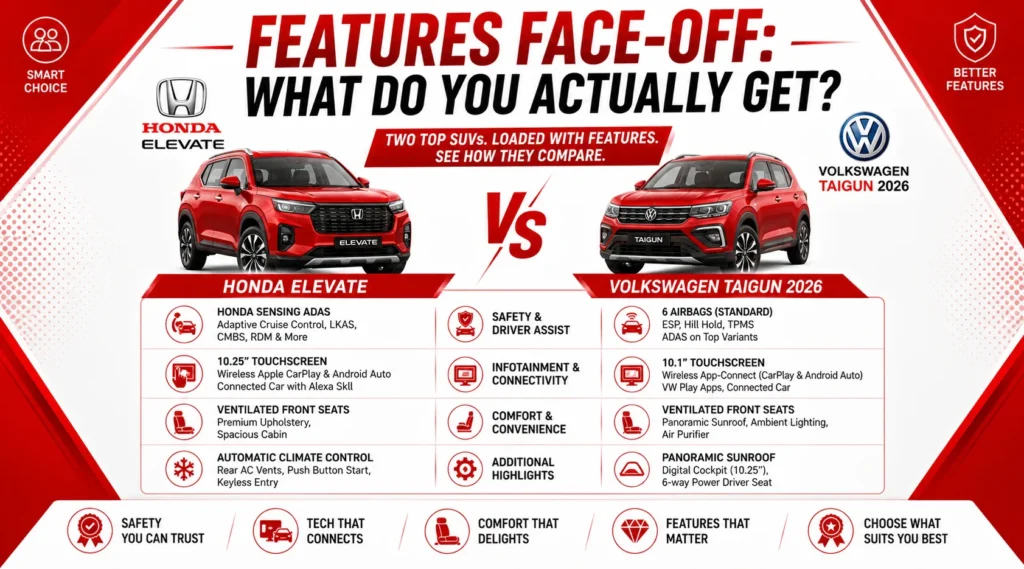
The 2026 Volkswagen Taigun facelift gets a more premium, tech-focused approach. Now it adds a panoramic sunroof, a larger 10.1-inch touchscreen with Google Voice Assistant, a 10.25-inch digital instrument cluster, wireless charging, ambient lighting, power- and ventilated front seats, and connected LED lighting with illuminated Volkswagen logos. GT versions enhance the experience with a flat-bottom steering wheel, paddle shifters and sporty interior touches. Cabin tech-wise, the Taigun is more contemporary and premium, but it’s clearly the Elevate that wins out, thanks to its full suite of ADAS. If you want advanced driver assistance, the Elevate may be for you. If you want a richer in-cabin tech experience, the Taigun may be the pick for you.
Safety Features: Who Keeps You Safer?
The Honda Elevate has 6 airbags as standard on its top trims. Plus, it comes with ABS and EBD, ESC, Hill Start Assist, and tire pressure monitoring. The Honda Sensing ADAS suite is available on the ZX variants as well, including features such as collision mitigation braking, road departure mitigation, lane departure warning, and adaptive cruise control. However, it hasn’t been rated by Global NCAP yet, leaving some consumers wanting, since they need those crash test scores to feel at ease.
Volkswagen Taigun carries a well-earned 5-star Global NCAP rating — one of the best safety credentials in the compact SUV segment. It offers 6 airbags as standard across all variants (not just the top ones), along with ESC, traction control, electronic differential lock, hill hold assist, multi-collision braking, brake disc wiping, ISOFIX child seat anchors, front and rear parking sensors with both visual and audio feedback, and an auto-dimming rear-view mirror. The 1.5L variants also get rear disc brakes.
If a proven crash test rating is non-negotiable for you, the Taigun is the safer choice on paper. If you want a car that actively helps you avoid getting into an accident in the first place, Honda Sensing on the Elevate is more advanced in that regard.
Which One Should You Buy?
Here is the honest answer: there is no universal winner. These are two genuinely good cars that cater to slightly different buyers.
Buy the Honda Elevate if:
- You carry a full family regularly and rear comfort matters a lot
- You want ADAS driver-assist features at this price point
- You prefer a smooth, low-maintenance driving experience in city traffic
- A larger boot and more cabin space are priorities
Buy the Volkswagen Taigun if:
- You want a car that feels and drives more premium
- You cover highway miles regularly and want turbo power
- A 5-star NCAP crash safety rating is important to you
- You want the latest tech — panoramic sunroof, digital cluster, new 8-speed auto
Both cars are similarly priced to start, but the Volkswagen Taigun gets way more expensive than the Elevate’s upper end. And if you’re looking at the ₹15-16 lakh bracket, the Elevate makes more sense. Have some extra cash to waste? The GT variants of the Taigun offer you a real step up in luxury, at ₹17-19 lakh. In the end, the Elevate is the safer pick as a family vehicle. “The Taigun is all about the fun of driving and enjoying roads. Test drive both, and you’ll probably know immediately which one feels right.
FAQ
Q1. Which car gives better mileage, the Elevate or the Taigun?
A. The Taigun triumphs the competition when it comes to fuel efficiency. It gets 18.85-19.98 kmpl for its 1.0L TSI variants, way more than the Elevate’s 15.31-16.92 kmpl. So with its turbo-petrol engine and Active Cylinder Technology, it stands out on long drives.
Q2. Is the Honda Elevate safer than the Volkswagen Taigun?
A. Both cars are safe, just in different ways. The Taigun gets a 5-star Global NCAP crash test rating, showing its independent safety creds. The Elevate doesn’t have an NCAP rating yet, though its top versions have Honda Sensing ADAS to help prevent accidents. So, if you want crash protection, go with the Taigun. But for active accident prevention, the Elevate’s your better bet.
Q3. Which SUV has more space, Elevate or Taigun?
A. The Volkswagen Elevate has more room inside. It’s longer, wider, and taller than the Taigun, with a bigger boot too, 458 liters compared to the Taigun’s 385 liters. Plus, the rear seat legroom and headroom are more spacious in the Elevate, making it perfect for families traveling with many passengers.
Q4. Which one is better for highway driving?
A. The Taigun’s got a serious edge with its turbo-petrol engines. Its 1.5L TSI, in particular, putting out 150 hp and 250 Nm, feels strong on the highway. With the 7-speed DSG, overtaking is a breeze. The Elevate’s naturally aspirated engine is comfy around town, but it falls short on long expressways.
Q5. Which car offers better value for money overall?
A. It depends on your budget. Up to ₹15-16 lakh, the Honda Elevate gives you more space, comfort, and ADAS features for the money, hard to beat at that price. If you’re stretching to ₹17-19 lakh, the Taigun GT variants feel significantly more premium and rewarding to drive. Both are good value; it just depends on how much you’re willing to spend.